Beyond the Cloud: A Guide to Peer-to-Peer Autonomous Commerce
- The Centralized Gap: Why Apps Fail in the Wild
In the rugged topography of the New River Gorge, the promise of modern “cloud-based” convenience often dissolves into a sequence of spinning loading icons and failed API calls. For an outdoor outfitter in Fayetteville, West Virginia, the legacy software stack isn’t just an inconvenience—it is an extractive force that drains local economic value.
Traditional platforms, or “Centralized Aggregators,” function as gatekeepers that demand a significant toll while offering zero resilience in the mountain hollows where cellular signals vanish. To understand the architectural shift required for true local sovereignty, we must contrast the extractive old way with the retentive new way of the Pawnee.us A2A Sovereign Engine.
Dimension Centralized Aggregators (The “Old Way”) A2A Sovereign Engine (The “New Way”)
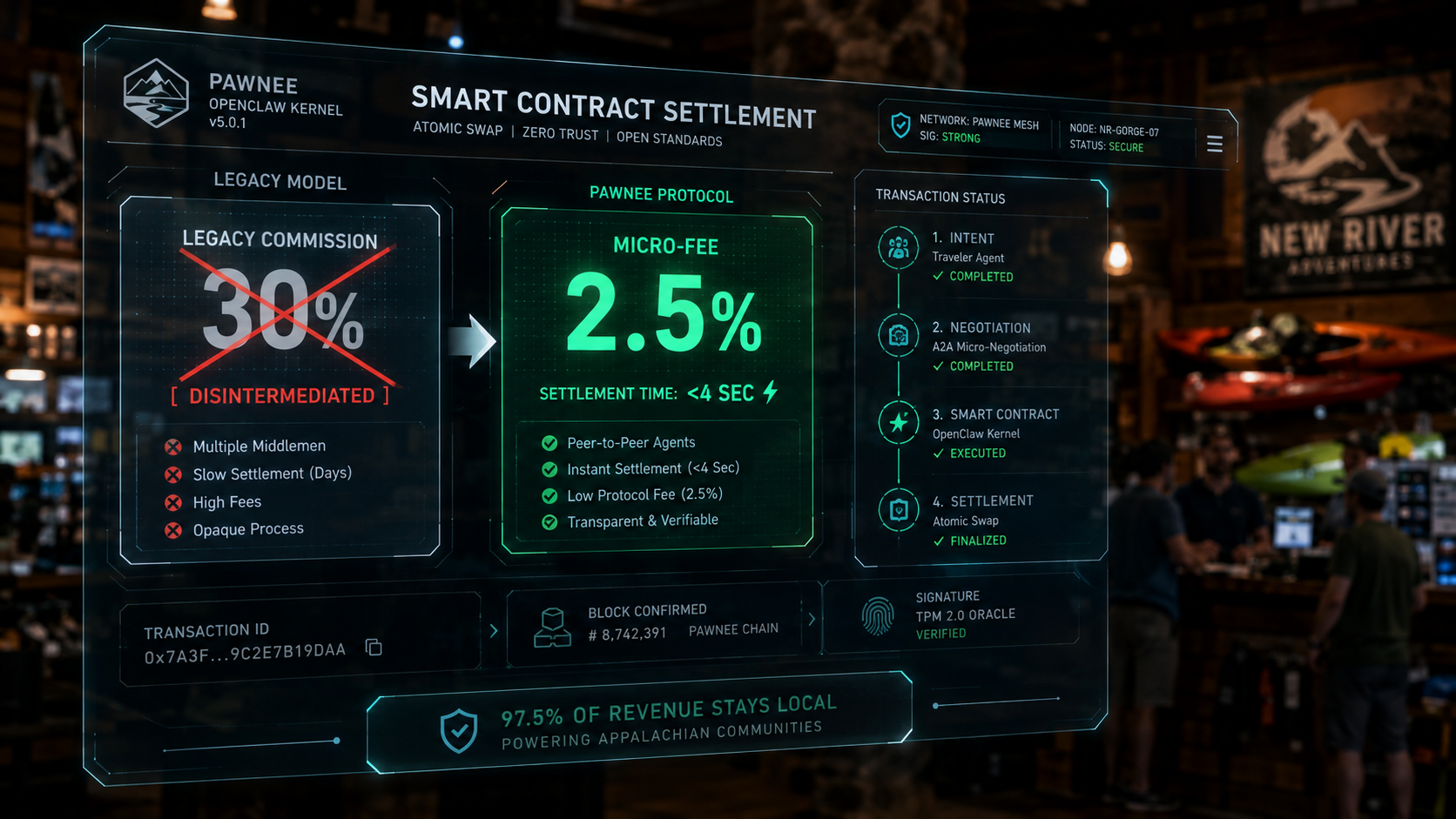
Commission Fees 15% to 30% (Expedia/Viator) 2.5% Decentralized Protocol Micro-Fee
Connectivity Dependency 100% Cloud-Dependent (fails in dead zones) Air-Gapped Mesh (Hyphanet/NeoMesh)
Confirmation Speed 5 to 15 Minutes (manual browsing) < 4 Seconds (autonomous negotiation)
Economic Flow Extractive (Capital leaks to Seattle/SF) Retentive (Capital stays in the Gorge)

For a local business, the “so what” is devastatingly clear: 30% fees are a tax on the community’s natural assets, and connectivity dependency creates a single point of failure that results in missed shuttles and double-bookings. To solve this, we must transition the “brain” of the transaction from a distant, vulnerable cloud to a local, resilient network edge.
- The A2A Engine: Meet Your Personal Digital Negotiator
The heart of this architecture is the Agent-to-Agent (A2A) protocol, powered by the OpenClaw kernel. OpenClaw is an ultra-lightweight agentic kernel specifically optimized for low-latency edge deployment. This technology shifts the burden of commerce from the human to a software representative.
Definition: Personal AI Agent In the A2A ecosystem, an agent is not a chatbot; it is a persistent digital negotiator. It is an autonomous software entity that maintains a traveler’s cryptographic identity and executes atomic smart contracts based on pre-defined user parameters.
Rather than a human spending twenty minutes navigating fragmented apps, the OpenClaw agent operates within a 4-second negotiation window. It evaluates “multi-attribute decision trees”—simultaneously balancing price, time, location, and even local climate data—to secure the optimal path for its human principal. This speed is made possible because these agents do not wait for a central server to grant permission; they talk directly to other agents on the local mesh.
- Business Without Bars: The Local Mesh Network
When cellular and fiber connectivity fail, the system relies on a physical “Sovereign Stack” of hardware. This layer replaces the standard internet with a local P2P infrastructure using Hyphanet/NeoMesh protocols. The deployment utilizes three “WISP-in-a-Box” gateways:
- WISP-in-a-Box Agentic ($9,997.00)
- Primary Function: Acts as the local AI server, housing the OpenClaw execution environment and local LLM inference engines.
- Learner’s Insight: This unit allows AI “thinking” to occur locally. By housing the LLM at the edge, the business eliminates the latency and privacy risks of the cloud, becoming a self-contained data center.
- WISP-in-a-Box LTE ($5,887.00)
- Primary Function: Provides dual-WAN failover (Starlink satellite + LTE) to sync local A2A ledger states with the wider world.
- Learner’s Insight: This serves as the “bridge” to the global economy, ensuring that while the transaction happens locally and instantly, the records eventually reach the global ledger once a signal is available.
- WISP-in-a-Box Base ($1,497.00)
- Primary Function: Handles short-range “guest handshakes” via Bluetooth or Wi-Fi.
- Learner’s Insight: This is the terminal point for the traveler. It allows a wearable or phone to securely introduce the traveler’s agent to the merchant’s network without requiring a cellular bars or a data plan.
- The Saturday Morning Symphony: A Play-by-Play of A2A Commerce
To see the “Triple-Value Engine” in motion, consider a typical Saturday at 8:15 AM in Fayetteville. A traveler steps out of an eco-pod with a $350 budget and an intent for adventure. In under four seconds, a series of pings orchestrates the day:
- The Outfitter Ping: The traveler’s agent pings the Whitewater Outfitter Agent, securing a 10:00 AM kayak slot at a direct-merchant rate, bypassing the 30% “Expedia tax.”
- The Fleet Ping: The traveler’s agent pings the Fleet Agent, which triggers the autonomous dispatch of a Pawnee Hybrid Dune Buggy for a 9:30 AM pickup.
- The Kitchen Ping: The agent pings a Drone Kitchen Agent at a local farm-to-table co-op, scheduling a hot meal to be delivered by drone to Mile Marker 6 at 1:15 PM.
- The Settlement: The contracts are verified via hardware and settled instantly for a 2.5% protocol micro-fee.
This entire symphony occurs without a credit card form, a cloud server, or a cellular signal. The agents manage the budget and the logic, while the mesh hardware facilitates the physical movement of buggies and drones.
- The Silicon Seal: How TPM 2.0 Replaces Human Trust
For this decentralized magic to be viable, it must be more secure than the centralized databases it replaces. The A2A system utilizes a Zero-Trust environment where “Silicon Trust” replaces “Human Trust” through a hardware-secured TPM 2.0 (Trusted Platform Module) Oracle.
Every transaction is cryptographically signed by a silicon chip embedded in the WISP hardware, ensuring that data packets cannot be spoofed or double-spent. The protocol generates a unique signature for every event:
Signature_A2A = Sign_TPM_PrivateKey(Agent_ID + Timestamp + Price + GPS_Location)
The “So What”: By using a hardware root-of-trust, the local mesh becomes a fortress. Unlike a centralized cloud database—which acts as a “honeypot” for global hackers—the A2A ledger is distributed, air-gapped, and secured by physical silicon, making it the most secure commerce environment in existence.
- The Economic Impact: From Extraction to Retention
The shift to A2A commerce creates a “Triple-Value Engine” that transforms the financial health of the region:
- The Commission Shift: By replacing 30% extractive fees with a 2.5% protocol micro-fee, local merchants retain 97.5% of their gross revenue. This is a direct injection of capital into the local economy that would otherwise have been exported to Silicon Valley.
- Regulatory Advantage: This system operates under the protection of West Virginia H.B. 2014 (W. Va. Code §5B-2-21 & §24-2-21a). These statutes certify local microgrid programs, exempting them from traditional utility oversight and ensuring the commerce network remains a “Captive Power” environment.
- The Wealth Ripple: A portion of the protocol fee (0.5%) is directed to a developer fund. This fund specifically supports the 321M NSF RETI Consortium and WVU Statler College students. Local fellows are paid to maintain the very network they use, creating a virtuous cycle of high-tech talent retention in Appalachia.
A2A commerce represents the technological frontier of the High-Margin Outdoor Economy. By integrating OpenClaw agents, WISP-in-a-Box mesh hardware, and TPM 2.0 silicon security, communities can reclaim their sovereignty from centralized monopolies. This ensures that commerce remains resilient, autonomous, and—most importantly—profitable for the people who actually own the land and the equipment.