• Skip to primary navigation
  • Skip to main content
DeReticular

DeReticular

Local Autonomy. National Security. Total Sovereignty.

  • Solutions
    • Municipalities
    • Energy
    • Industrial
    • Defense
  • Infrastructure
  • Intelligence
  • Company
  • Request Municipal Audit
  • Show Search
Hide Search
You are here: Home / Archives for Michael Noel

Michael Noel

Comprehensive Analysis of the DeReticular Sovereign Automation Ecosystem

Michael Noel · March 13, 2026 ·

Executive Summary

The DeReticular Sovereign Automation ecosystem represents a paradigm shift in industrial, municipal, and commercial infrastructure, prioritizing absolute digital sovereignty through localized, air-gapped AI operations. By eliminating dependencies on centralized cloud providers, the ecosystem addresses critical vulnerabilities related to data privacy, intellectual property theft, and high-latency robotics.

The product suite scales from individual small business solutions to massive urban operating systems, utilizing a modular architecture of specialized AI agents: DevOps Sovereign (Deep Admin) for cyber-defense and IT maintenance, Sovereign Executive for administrative automation, Industrial Foreman for machinery orchestration and energy management, and Vault Warden for physical security and volumetric monitoring. Central to the enterprise-tier offerings is the Digital Twin technology, providing real-time 3D simulations that synchronize perfectly with physical operations to optimize production and security.

Key takeaways include:

  • “Island Mode” Resilience: All systems are designed to operate without macro-internet access, ensuring continuity during regional outages or cyberattacks.
  • Hardware-Agnostic Integration: Proprietary “Foreman” nodes bridge legacy industrial protocols (PLC/SCADA) and modern machinery (ISOBUS/CAN Bus) into a unified AI network.
  • Economic Sovereignty: Municipal and urban packages include concierge AI to facilitate local hospitality and commerce, removing extractive third-party “SaaS” fees.
  • Cryptographic Trust: Every deployment utilizes a localized Root Certificate Authority (CA) to establish secure, encrypted communication across mesh networks.

——————————————————————————–

1. Core Software Agents and Intelligence Modules

The ecosystem’s functionality is driven by the “OpenClaw” suite of AI agents, each designed for specific operational domains.

AgentPrimary RoleKey Capabilities
DevOps Sovereign (Deep Admin)Cyber-Defense & ITLog ingestion, autonomous patching, self-healing networks, and active threat blocking.
Sovereign ExecutiveAdministrativeVoice-to-text (The Scribe), OCR/document filing (The Archivist), and private scheduling (The Gatekeeper).
Industrial ForemanOrchestrationPLC/SCADA bridging, AGV/fleet routing, P2P energy negotiation, and sub-millisecond anomaly response.
Vault WardenPhysical SecurityLiDAR-based volumetric mapping, multispectral provenance matching, and autonomous lockdowns.

Technical Modules

  • The Scribe & Archivist: Utilizes Whisper AI for secure, hands-free dictation and Tesseract/OCR for digitizing paper records (e.g., medical records, invoices, legal briefs).
  • Digital Twin Engine: GPU-accelerated clusters (Forge/Fortress editions) that render 3D simulations using LiDAR data to track inventory, personnel, and machinery with millimeter precision.

Severing the Cloud With Sovereign Automation

2. Infrastructure and Networking

The ecosystem utilizes a decentralized mesh network to maintain high-speed connectivity without external dependencies.

  • Nomad Mesh-Points: Ruggedized Wi-Fi 6E and LoRaWAN routers that create an “un-killable” intranet canopy. These units automatically peer with neighboring nodes and support LoRaWAN failover for critical data when high-bandwidth signals are obstructed.
  • Private 5G (Nomad Forge-Points): Ultra-low latency access points (<5ms) designed for environments with heavy machinery interference, ensuring autonomous robots never lose connection.
  • Root Certificate Authority (CA): Each package instantiates a unique Root CA, establishing a “Root of Trust.” This ensures that only cryptographically verified hardware can negotiate power, data, or kinetic commands on the network.

——————————————————————————–

3. Specialized Product Bundles by Scale

Individual and Small Business Solutions

  • Main Street Commerce Bundle ($449): Provides small businesses (CPAs, clinics, mechanics) with a Nomad Mesh-Point and Sovereign Executive AI. Focuses on “Island Mode” automation for scheduling and document sorting.
  • Resilient Microgrid Utility Bundle ($999): An autonomous P2P energy negotiator. It unifies disparate solar inverter brands (Victron, SMA, etc.) to balance community power loads and manage “dump loads” for thermal storage.
  • Municipal Citadel Security Bundle ($2,499): An air-gapped physical defense system using 3D LiDAR and multispectral cameras to protect high-value assets like evidence rooms or credit union vaults.

Enterprise and Industrial Packages

  • Sovereign Forge Manufacturing ($249,999): A localized AI OS for the factory floor. It integrates 250+ IoT nodes to bridge legacy machinery and powers a live Digital Twin for real-time production optimization.
  • Sovereign Harvest Agro-Industrial ($85,999): An autonomous farm OS that manages LoRaWAN soil sensor grids and autonomous heavy machinery (tractors/harvesters) via ISOBUS/CAN Bus integration. It includes dedicated veterinary AI for hands-free medical logging.
  • Sovereign Fortress Asset Protection ($549,999): Designed for bullion depositories and museums. It uses “Spectral Provenance” to verify the molecular signatures of assets (e.g., pigment density in art) and provides immutable audit logs to insurance underwriters to reduce premiums.

Municipal and Urban Infrastructure

  • Village Genesis ($49,999): A turnkey OS for 100–1,000 residents, including medical/legal sub-nets and autonomous transit.
  • City Infrastructure Nexus ($129,999): Scales for 1,000–3,000 residents with a 36-node mesh and dual-redundant data centers.
  • Urban Hub Infrastructure ($389,999): For 3,000–10,000 residents. Includes a 100-node mesh, 15 autonomous transit vehicles, and tri-redundant “active-active-active” Sentry Pro Clusters.

——————————————————————————–

4. Key Functional Capabilities

Autonomous Fleet Management (Nomad Fleet Kits)

The system integrates directly into the CAN Bus or ISOBUS of vehicles—ranging from forklifts and municipal shuttles to combine harvesters and armored trucks.

  • Spatial Pathfinding: Vehicles use LiDAR-synced Digital Twin data for navigation and collision avoidance.
  • GPS-Denied Navigation: Capabilities include dead-reckoning inside shielded vaults or geofenced routing in rural/urban environments.
  • Right-to-Repair Sovereignty: In agricultural contexts, the system allows farmers to intercept machine codes and maintain equipment locally, bypassing manufacturer software locks.

Cyber-Defense and Self-Healing (Digital Nervous System)

The Digital Nervous System (DNS) Core Bundle ($4,999) acts as the vigilant brain of a municipal intranet.

  • Active Defense: The Deep Admin identifies ransomware probes or brute-force attacks by analyzing logs across all connected nodes and can null-route malicious IPs at the town’s perimeter.
  • Autonomous Maintenance: The system can detect “heartbeat” failures in subordinate nodes and automatically execute repair runbooks or restart services via the mesh.

Insurance and Compliance

High-tier packages like the Sovereign Fortress generate cryptographically verifiable audit logs. By eliminating human error and cloud-hacking vulnerabilities, the system provides insurance underwriters with “Proof of Existence” and climate-control heartbeats, leading to significant premium reductions.

——————————————————————————–

5. Risk Mitigation and Reliability

Risk CategoryDescriptionMitigation Strategy
LatencyCloud lag in robotics causing accidents.Absolute Edge Compute: All processing is on-premise, ensuring <5ms latency for kinetic operations.
EspionageCompetitors stealing proprietary data/CAD files.Air-Gapped Vaults: Strict “Island Mode” with no physical egress to the macro-internet.
InterferenceRF signals blocked by dense construction or hills.Hybrid Routing: Use of LoRaWAN failover and “Tractor-as-a-Relay” mobile mesh repeaters.
TamperingPhysical theft or breach of edge nodes.Cryptographic Suicide: Nodes wipe RAM and blacklist themselves at the Root CA if breached or disconnected for >15 minutes.

Sovereign_AutomationDownload

6. Fulfillment and Integration Workflow

The deployment of these systems follows a specialized three-phase hybrid workflow:

  1. Phase 1: Architecture & Calibration: Human-led ingestion of client CAD/BIM data, topography mapping (RF site surveys), and the minting of the Root CA.
  2. Phase 2: Fleet Provisioning: Hardware is staged in DeReticular warehouses, flashed with the RIOS Core OS, and subjected to 48–72 hour burn-in tests (stressing GPU clusters with LLM inference). Shipment is handled via dedicated LTL freight.
  3. Phase 3: Deployment: Physical installation by DeReticular technicians or local contractors. This includes “Core Ignition” of clusters and the “Golden State” calibration, where physical assets are baselined into the Digital Twin.

Automated critical infrastructure like heavy machinery, voting terminals, and agricultural systems.

Michael Noel · March 13, 2026 ·

Sovereign Automation Ecosystem, a suite of localized, air-gapped AI agents designed by DeReticular to eliminate cloud dependency. These specialized tools, such as the Field Medic, Industrial Foreman, and Sovereign Elector, utilize the OpenClaw framework to manage critical infrastructure like heavy machinery, voting terminals, and agricultural systems. By hosting large language models and computer vision engines directly on ruggedized Sentry and Deck hardware, the system ensures absolute data privacy and “Island Mode” resilience. The ecosystem further integrates the Locutus Ledger for cryptographic “Proof of Labor” and immutable record-keeping across various industrial and civic sectors. Ultimately, these sources describe a paradigm shift toward sovereign infrastructure, where AI interacts directly with the physical world without leaking proprietary information to external providers.

DeReticular Sovereign Automation: A Comprehensive Ecosystem Briefing

Michael Noel · March 12, 2026 ·

Sovereign_AutomationDownload

1.

1. Executive Summary

DeReticular’s Sovereign Automation product line represents a fundamental shift in industrial and civic infrastructure, transitioning from passive, cloud-dependent hardware to active, cyber-physical agents. By marrying ruggedized “RIOS” hardware with localized AI via the OpenClaw framework, DeReticular enables “Island Mode” operations—fully functional, autonomous environments that require zero internet connectivity and ensure absolute data sovereignty.

The ecosystem is designed to “animate infrastructure,” placing Large Language Models (LLMs), Vision-Language Models (VLMs), and cryptographic ledgers directly at the edge. This eliminates the “Privacy Paradox” and cloud vulnerabilities inherent in modern Big Tech solutions. Whether diagnosing a diesel generator in a jungle (The Field Medic), securing a high-value art vault (The Vault Warden), or managing a decentralized travel consortium (The Sovereign Wayfarer), the ecosystem prioritizes physical resilience, local intelligence, and cryptographically verifiable results.

——————————————————————————–

2. Strategic Philosophy and Core Technology

The DeReticular ecosystem is built upon several unifying technological pillars that differentiate it from centralized “SaaS” (Software as a Service) competitors.

2.1 The OpenClaw AI Framework

OpenClaw serves as the underlying logic engine across all automation products. It is specialized to act as a sysadmin, a robotic kinematics solver, an industrial foreman, or a cognitive assistant, depending on the deployment. It primarily utilizes quantized Llama-3-8B models for natural language reasoning without external data exfiltration.

2.2 The Locutus Ledger

A decentralized blockchain/smart contract network used for:

  • Proof of Labor: Logging robotic arm movements.
  • Proof of Existence: Security heartbeats for high-value assets.
  • Smart Escrow: Managing instant, cross-border financial settlements.
  • Proof of Sustainability: Minting verifiable ESG and carbon credits for agriculture.
Cutting the cloud cord with sovereign AI

2.3 Hardware Dependency and “Island Mode”

All agents are hosted on local hardware (primarily the Sovereign Sentry or Nomad Link) to ensure “Zero-Cloud Resilience.”

  • Sovereign Sentry (Pro): Features an Intel Core i3-N305 8-Core CPU and up to 64GB RAM to support heavy parallel VM and LLM execution.
  • Sovereign Deck: A 10-inch ruggedized tactical tablet (IP68) used as a mobile interface for mechanics and technicians.
  • Nomad Link: Provides LTE failover and satellite bonding (Starlink) for persistent connectivity in mobile environments.

——————————————————————————–

3. Product Line Analysis

The Sovereign Automation suite is categorized into specialized deployments fine-tuned for specific industry roles.

3.1 Industrial and Maintenance Agents

Product NameSKURolePrimary Function
The Field MedicSOV-AUTO-MEDICAutonomous MechanicUses VLM to identify broken parts and synthesize repair guides via a 4TB local vector database.
Industrial ForemanSOV-AUTO-GRIDGrid & Logistics ManagerAutomates energy management (RS485/Modbus) and supply chain logistics (GPS geofencing).
Sovereign ForgeSOV-AUTO-FORGEAerospace ManufacturingMonitors 3D printing in real-time to generate Digital Twins and digital FAA Form 8130-3s.
Sovereign Helping HandSOV-ROBO-HANDPhysical ManipulatorA 6-axis, IP67-rated robotic arm for autonomous harvesting, hardware reboots, or hazardous tasks.

3.2 Civic and Agricultural Infrastructure

Product NameSKURolePrimary Function
Sovereign ElectorSOV-CIVIC-ELECTORVoting TerminalAir-Gapped system with Split-Ledger architecture and Voter-Verified Paper Audit Trails (VVPAT).
Sovereign AgronomistSOV-AUTO-AGRIPrecision FarmingManages LoRaWAN sensors for irrigation, pest defense, and ESG/Carbon Credit minting.
Sovereign WISP KitRIOS-KIT-WISPTurnkey Micro-ISPTransforms a Starlink connection into an automated Wi-Fi business with billing and QoS.
Marina AutomationSOV-AUTO-DOCKHarbor ManagerHandles slip booking, automated bilge-pump activation, and fuel tank compliance.

3.3 Digital and Administrative Sovereignty

Product NameSKURolePrimary Function
DevOps SovereignSOV-AUTO-DEVSr. SysAdminAir-gapped code reviewer and self-healing log sentinel; requires 32GB RAM.
Sovereign ExecutiveSOV-AUTO-EXECAdmin AssistantLocal voice transcription (Whisper), OCR, and private scheduling for HNW individuals.
Sovereign Support DeskSOV-AUTO-HELPIT HelpdeskL1 Triage and L2 Remediation engine using local RAG knowledge bases.
Sovereign WayfarerSOV-AUTO-WAYFARETravel NodeDecentralized B2B travel consortium with instant smart-contract commission splits.

——————————————————————————–

4. Key Operational Workflows

4.1 “The Mud & Oil Scenario” (The Field Medic)

The Field Medic operates where the cloud cannot reach.

  1. Visual Input: A technician photographs a failed component (e.g., a fuel solenoid).
  2. Processing: The OpenClaw agent performs a semantic visual lookup against a local Milvus Vector Database of millions of pages of manuals.
  3. Synthesis: It identifies the part and provides a step-by-step bypass or repair guide.
  4. Logging: Completion is hashed and committed to the Locutus Ledger for an immutable maintenance record.

4.2 The Split-Ledger Ballot (The Sovereign Elector)

To reconcile anonymity with verification, the Elector uses a two-phase architecture:

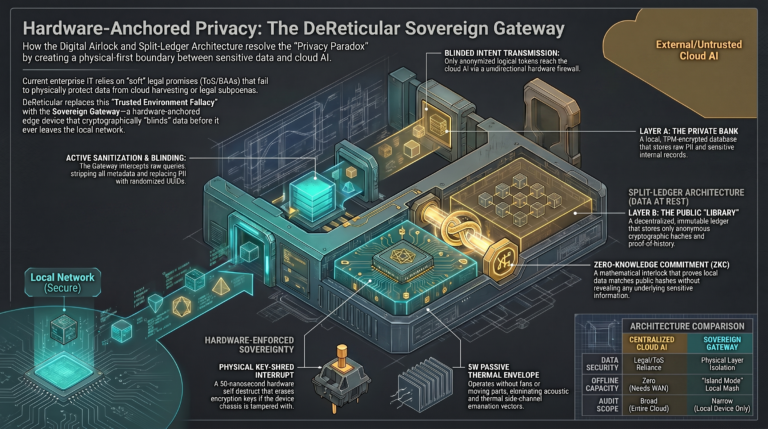
  • Private Ledger: Authenticates the voter’s identity at check-in.
  • Public Ledger: Records a cryptographically signed Cast Vote Record (CVR) that contains no identity data, generated by the hardware’s TPM 2.0 module.
  • Physical Verification: A physical paper ballot (VVPAT) remains the ultimate legal authority for recounts.

4.3 Volumetric and Spectral Security (The Vault Warden)

The Vault Warden protects high-value assets through sensor fusion:

  • LiDAR: Creates a 3D “Volumetric Cage” to detect mass displacement >2mm.
  • Multispectral Vision: Verifies the spectral signature of pigments on a canvas to prevent forgery swaps.
  • Active Countermeasures: Can autonomously trigger mag-locks or sirens via GPIO relays if a “Critical Threat” is detected.

——————————————————————————–

5. Economic and Strategic Impact

5.1 Financial Roles and Profit Centers

  • The Vault Warden (SaaS Driver): Priced at $99.00/month, this is a recurring profit center targeting high-net-worth clients with low price sensitivity.
  • The DevOps Sovereign (Premium Injector): Commands a $499.00 perpetual license and drives high-margin sales for the 32GB Sovereign Sentry Pro hardware.
  • The Sovereign Executive (Ecosystem On-Ramp): A lower-cost $199.00 entry point that builds brand trust for solopreneurs and small businesses.

5.2 ROI for Remote Industry

Currently, generator failures at remote mining sites can cost $50,000 per day in downtime while waiting for specialized technicians. The Field Medic allows local, junior mechanics to perform master-level repairs in minutes using localized AI knowledge. Similarly, the Sovereign Marina Suite reduces liability by preventing vessel sinkings through autonomous bilge-pump activation.

5.3 Decentralization of Intelligence

By deploying the “Sovereign WISP Kit,” DeReticular enables “Sovereign Entrepreneurs” to turn passive infrastructure into profit centers. The node operator can resell bandwidth and LoRaWAN backhaul, with the “Tollbooth” agent automatically splitting margins between the operator and the DeReticular ecosystem via the Locutus Ledger.

——————————————————————————–

6. Risk Register and Mitigation

Risk IDDescriptionMitigation Strategy
R-QA-01Visual Hallucination (AI misidentifies high-pressure lines).Hardcoded confidence thresholds; AI refuses instructions if confidence is <95%.
R-VOTE-01Network Tampering in Elections.Physical Air-Gap; Sovereign Decks lack Wi-Fi/LTE chips entirely.
R-PWR-01Targeted Grid Attacks/Power Loss.Nomad Failover; systems operate on <15W and include LiFePO4 battery backups.
R-SEC-01IP Theft of proprietary CAD files.Ephemeral Decryption; sensitive files are decrypted in volatile RAM and wiped after use.
R-KIN-01Robotic Collision (Helping Hand).Strict hardware torque limits (Cobot standards) and vision-based obstacle detection.

——————————————————————————–

Authority: Remnant / Autonomous Infrastructure Steering Committee

The Field Medic: Remote Maintenance & Heavy Equipment Diagnostics Suite

Michael Noel · March 11, 2026 ·

Sovereign_Field_MedicDownload

Executive Summary

The Field Medic (SOV-AUTO-MEDIC) is an autonomous, multi-modal AI maintenance agent designed by DeReticular’s Autonomous Infrastructure & Right-to-Repair Division. Engineered for environments where cloud connectivity is non-existent, the suite functions as a local, “Right-to-Repair” weapon against OEM-enforced digital rights management (DRM) and paywalled repair knowledge. By combining a localized 8B-parameter Vision-Language Model (VLM) with a massive NVMe-based vector database of service manuals, the system allows technicians to diagnose and repair complex heavy machinery—ranging from legacy 1990s diesel generators to modern agricultural equipment—with zero internet connection. The Field Medic essentially elevates junior technicians to master-level mechanics, drastically reducing industrial downtime and the logistical costs of remote repairs.

1. Product Identity and Specifications

The Field Medic is a specialized software and hardware integration designed for Sovereign Power Technicians (SPTs), combat engineers, and operators in remote industries such as mining, farming, and offshore drilling.

  • Product Name: The Field Medic (Remote Maintenance & Diagnostics Agent)
  • SKU: SOV-AUTO-MEDIC
  • Target MSRP: $1,299.00 (Software & Base Vector Library) + Hardware costs
  • Format: Containerized Digital Download (Air-Gapped Container & Vector Weights)
  • Primary Roles: Autonomous AI Mechanic, Visual Schematic Locator, Right-to-Repair Override, Maintenance Ledger.
  • Hardware Dependency: Requires the Sovereign Deck, a ruggedized tactical tablet featuring local LLM compute and 4TB+ NVMe storage.

2. Technical Infrastructure

The system operates through three primary software components hosted on high-performance, local hardware.

A. Core Software (The “OpenClaw” Stack)

  1. OpenClaw “Medic” Image: A quantized, 8B-parameter Vision-Language Model (VLM) optimized for mechanical engineering and the interpretation of technical schematics. It serves as the core reasoning engine.
  2. The Archive (Local Vector Database): A compressed Milvus database stored on the Deck’s NVMe drive. It contains millions of pages of OCR’d service manuals, exploded-view diagrams, torque specifications, and legacy forum solutions dating from 1970 to the present.
  3. Locutus “Wrench” Daemon: A utility that cryptographically hashes and publishes repair records to a public or private ledger for warranty, resale auditing, and compliance.

B. Hardware (The Sovereign Deck)

  • Ruggedization: 10-inch tablet, IP68 rated against diesel fuel, hydraulic fluid, and mud.
  • Optics: High-resolution macro camera equipped with a dual-LED ring light for dark engine bays.
  • Compute: Integrated Neural Processing Unit (NPU) and unified memory architecture capable of running 8B-parameter models locally at 30+ tokens per second.

3. Operational Workflow: The “Mud & Oil” Scenario

The Field Medic is designed for rapid response in adverse conditions by technicians wearing protective gear.

  1. Input (Visual/Voice): The technician takes a photo of a corroded or unidentified part (e.g., a solenoid on a legacy solar pump) and asks a query via voice-to-text or the ruggedized chat interface (e.g., “What is this part and how do I bypass it?”).
  2. Processing (Local Reasoning): The OpenClaw agent extracts visual features like bolt patterns and casting marks. It performs a semantic visual lookup against the local Milvus Vector Database to identify the component.
  3. Output (Guided Repair): The system identifies the part (e.g., OEM Part #3931570), synthesizes a step-by-step bypass or repair guide, and displays the relevant PDF schematic with critical components highlighted in red.
  4. Logging (Verification): Upon completion, the repair—including photos, AI diagnosis, timestamp, and GPS coordinates—is hashed and committed to the Locutus Ledger. This creates an immutable record that increases equipment resale value and proves SLA compliance.

4. Advanced Diagnostic Capabilities

Beyond visual identification, the Field Medic includes specialized tools for mechanical and electronic diagnostics.

  • Acoustic Diagnostics (The Stethoscope): The agent can perform a Fast Fourier Transform (FFT) analysis on 10 seconds of recorded engine audio. By matching frequency anomalies against its database, it can calculate probabilities for specific failures, such as a spun main bearing (85%) versus a loose belt tensioner (15%).
  • CAN Bus Interfacing: To counter “Limp Mode” lockouts in modern tractors and heavy equipment, the system connects to OBD-II / J1939 CAN bus ports via a serial adapter. It translates proprietary fault codes into plain English and provides open-source commands to clear DRM lockouts.
  • Hot-Swappable Knowledge Cartridges: The vector database is modular. Companies can expand their local knowledge base using MicroSD or USB-C NVMe “Knowledge Cartridges” tailored to specific fleets (e.g., Mining Pack, Ag-Bot Pack, Aviation A&P Pack).
The air-gapped AI mechanic

5. Risk Register and Mitigation

Risk IDDescriptionMitigation Strategy
R-VIS-01Visual Hallucination: AI misidentifies a high-pressure line as low-pressure, causing a blowout.Confidence Thresholds: If visual confidence is <95%, the AI refuses instructions and requires manual part number verification.
R-ENV-01Lens Obscuration: Fuel or mud renders the VLM blind.Hardware/Alerts: Features sapphire glass lens covers; AI prompts user to wipe the lens and enable flash if the image is obscured.
R-DATA-01Outdated Manuals: The technician works on a 2026 engine but the Deck has not synced recently.Opportunistic Syncing: The Deck performs differential pulls (rsync) whenever it encounters a Sovereign Sentry or Mesh Beacon with internet.

6. Strategic Impact and ROI

The Field Medic fundamentally changes the economics of remote industrial operations:

  • Downtime Reduction: In scenarios where a generator failure at a remote mine can cost $50,000 per day, the Field Medic allows on-site staff to diagnose and bypass failures in minutes, rather than waiting for helicopter-deployed OEM technicians.
  • Technical Empowerment: It puts 50 years of industrial engineering knowledge into the hands of junior technicians, effectively removing the need for specialized training or cloud-based subscriptions.
  • Operational Sovereignty: The system ensures that owners maintain total control over their hardware, free from OEM-imposed repair barriers and connectivity dependencies.

The Death of the Line: 5 Takeaways from the Frontier of Sovereign AI Infrastructure

Michael Noel · March 11, 2026 ·

The_Sovereign_StackDownload

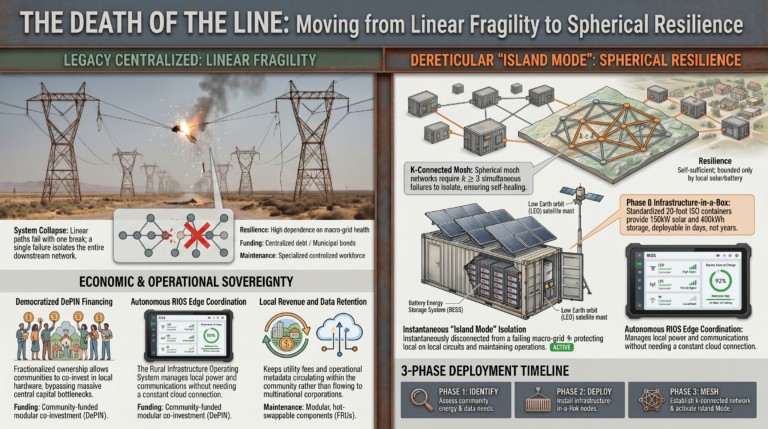
The modern world is suspended by a series of single points of failure. Our reliance on “The Line”—centralized power grids, municipal water, and fiber-optic backbones—has created a state of extreme fragility where geopolitical conflict or a singular natural disaster can trigger a cascading civilizational collapse. We are witnessing the emergence of a Sovereign Stack that renders the centralized cloud an elective luxury, not a necessity. This shift toward “Industrial Autarchy” is catalyzed by the convergence of ruggedized hardware and frontier AI models like Gemini 3.1 Pro and Claude 4.6. For organizations like DeReticular, the goal is clear: the decoupling of industrial destiny from centralized failure.

1. Spherical Resilience: Beyond the “Dumb Grid”

The “Death of the Line” philosophy marks the transition from vulnerable linear dependencies to “Spherical Resilience.” Through Project Octagon, DeReticular has deployed a planetary mesh of eight independent infrastructure nodes across extreme environments, from the Canadian tundra to the Arizona desert. These are not merely backup sites; they are sovereign entities capable of “Island Mode” operations.

Each node achieves Post-Grid Resilience by generating its own power via solar and plasma systems, establishing independent connectivity through Starlink and local mesh networking, and processing data at the edge. By migrating the orchestration of these nodes to Claude 4.6 on Vertex AI, DeReticular has moved beyond simple automation into complex, agent-led infrastructure management.

Analysis: Shifting from linear to spherical models is the only viable strategy for surviving “Black Swan” events. While a traditional grid is only as strong as its weakest segment, a spherical mesh ensures that the failure of a single node—or even a dozen—does not compromise the integrity of the collective system. This is the hallmark of a sovereign system: it is self-healing, self-contained, and fundamentally uncoupled from municipal fragility.

2. AI Executives: The Migration to Claude 4.6

Under the Rural/Robotic Infrastructure Operating System (RIOS), human management is being phased out in favor of “Persistent Intelligences.” These are not mere chatbots; they are AI executives integrated into the corporate and operational leadership. The two primary agents, Remnant and Thunder, have been migrated to Claude 4.6 on Vertex AI to leverage its advanced agentic tooling and industry-leading low hallucination rates.

Remnant serves as the “Dean of the Academy,” stress-testing nodes against total grid collapse. Its most critical function is managing “The Spark Spread,” a high-stakes resource allocation algorithm. Thunder, meanwhile, operates as an automated grant-writing agent to ensure continuous capital formation.

“Remnant… runs ‘Black Swan’ simulations to stress-test the nodes against total grid collapse and manages ‘The Spark Spread’—a real-time algorithm dictating whether a node should store energy, burn it for compute (Crypto/AI), or condense it into fuel.”

Analysis: Managing high-stakes resources like the “Spark Spread” in off-grid environments requires a level of precision that older models could not provide. The transition to Claude 4.6 is strategic: the model’s ability to handle complex, multi-step agentic workflows with enterprise-grade security allows RIOS to operate with near-zero human oversight. In harsh, remote environments where human intervention is logistically impossible, these autonomous executives provide a level of data-driven resilience that human management simply cannot match.

3. The Air-Gapped Helpdesk: Privacy as Industrial Security

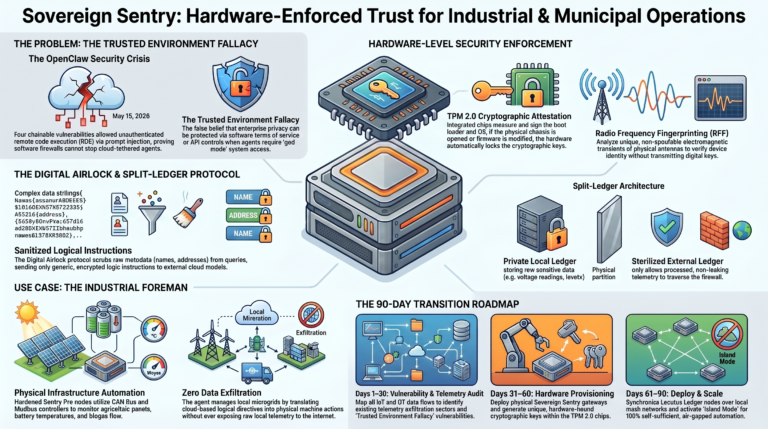
Traditional IT support is a security nightmare, often requiring proprietary network maps and admin credentials to be routed through cloud-based ticketing systems or public LLMs. The Sovereign Support Desk (L1 and L2) utilizes the OpenClaw framework to keep the “Brain” local. This system runs on the Sovereign Deck, a ruggedized HMI utilizing a hardened, locked-down Kali Linux kernel to prevent unauthorized over-the-air exploits.

The technical Bill of Materials (BOM) for this air-gapped support is specific:

  • Level 1 (Triage): Utilizes Llama-3-8B-Instruct-Quant-K4 for high-speed conversational support and local RAG via a Milvus vector database.
  • Level 2 (Remediation): Employs DeRet-Code-Admin-14B.gguf, a model fine-tuned specifically for SysAdmin scripts, bash commands, and hardware diagnostics.

Analysis: This privacy-maximalist approach is critical for industrial security. While public LLMs suffer from “data leakage,” the Sovereign Support Desk ensures that sensitive operational data never leaves the node. Furthermore, DeReticular has implemented a critical safety layer: the “Sovereign Key.” For any destructive command—such as wiping a drive or altering firewall rules—the AI prepares the script, but execution is blocked until a human administrator performs a physical human tap on a hardware key. This is the future of AI safety: agentic speed governed by physical human intent.

4. Mastering the Ground Truth: Gemini 3.1 Pro at the Edge

For autonomous infrastructure to be economically viable, it must be able to interpret the chaotic “Ground Truth” of the physical world. Gemini 3.1 Pro, deployed via Google Cloud’s Vertex AI, provides the deep reasoning necessary to manage robotic field rovers and complex logistics where traditional models fail.

By excelling at “edge cases”—the rare, unpredictable events like a pressure vessel rupture or a specific sensor malfunction—Gemini 3.1 Pro allows RIOS to solve multi-step problems autonomously.

“Gemini 3.1 Pro represents a clear quality leap… The model is stronger, faster, and more efficient, requiring fewer tokens while delivering more reliable results.” — Vladislav Tankov, Director of AI, JetBrains

Analysis: The synergy between Gemini 3.1 Pro and DeReticular hardware creates a more reliable “Ground Truth” for operations. By interpreting chaotic environmental data (such as real-time battery degradation or soil moisture), the AI can optimize a node’s performance to the point where the infrastructure essentially pays for itself. In a sovereign system, the model’s ability to handle the “edge case” is not a feature; it is the fundamental requirement for survival.

AI agents running DeReticular off grid nodes

5. Trustless Accountability: The Locutus Ledger

The Sovereign Stack enables a radical economic shift: the “Diesel to Data” economy. Instead of rural zones importing expensive fuel, they export high-value digital assets. Financial accountability in this decentralized network is managed via the Locutus Ledger, which utilizes the “Locutus SLA Daemon” to provide immutable “Proof of SLA.”

The system operates on a strict, automated logic:

  1. A support ticket is initiated and timestamped on the ledger.
  2. The AI agent (L1 or L2) resolves the issue.
  3. The Locutus Smart Contract calculates the time-to-resolution. If the issue is resolved in under 15 minutes, an escrow stablecoin payment is automatically unlocked for the service provider.

Analysis: This trustless billing system removes the administrative friction of human IT and accounting teams. By linking physical resolution directly to digital payment via the Locutus Ledger, DeReticular has created an autonomous economy. Data arbitrage allows these nodes to function not as cost centers, but as self-sustaining assets that generate value through their own operational efficiency.

Conclusion: The Sovereign Future

The convergence of frontier AI models like Gemini 3.1 Pro and Claude 4.6 with ruggedized, sovereign hardware marks the obsolescence of the “dumb grid.” We are moving toward a future defined by autonomous nodes and agent-led infrastructure that can withstand the collapse of centralized systems.

The technical tools for total industrial autarchy are now operational. The only remaining question is strategic: Are you ready to trade the familiar convenience of the centralized cloud for the hardened, unshakeable resilience of the Sovereign Stack?

  • « Go to Previous Page
  • Page 1
  • Interim pages omitted …
  • Page 12
  • Page 13
  • Page 14
  • Page 15
  • Page 16
  • Interim pages omitted …
  • Page 55
  • Go to Next Page »

DeReticular

Copyright © 2026 · Monochrome Pro on Genesis Framework · WordPress · Log in