
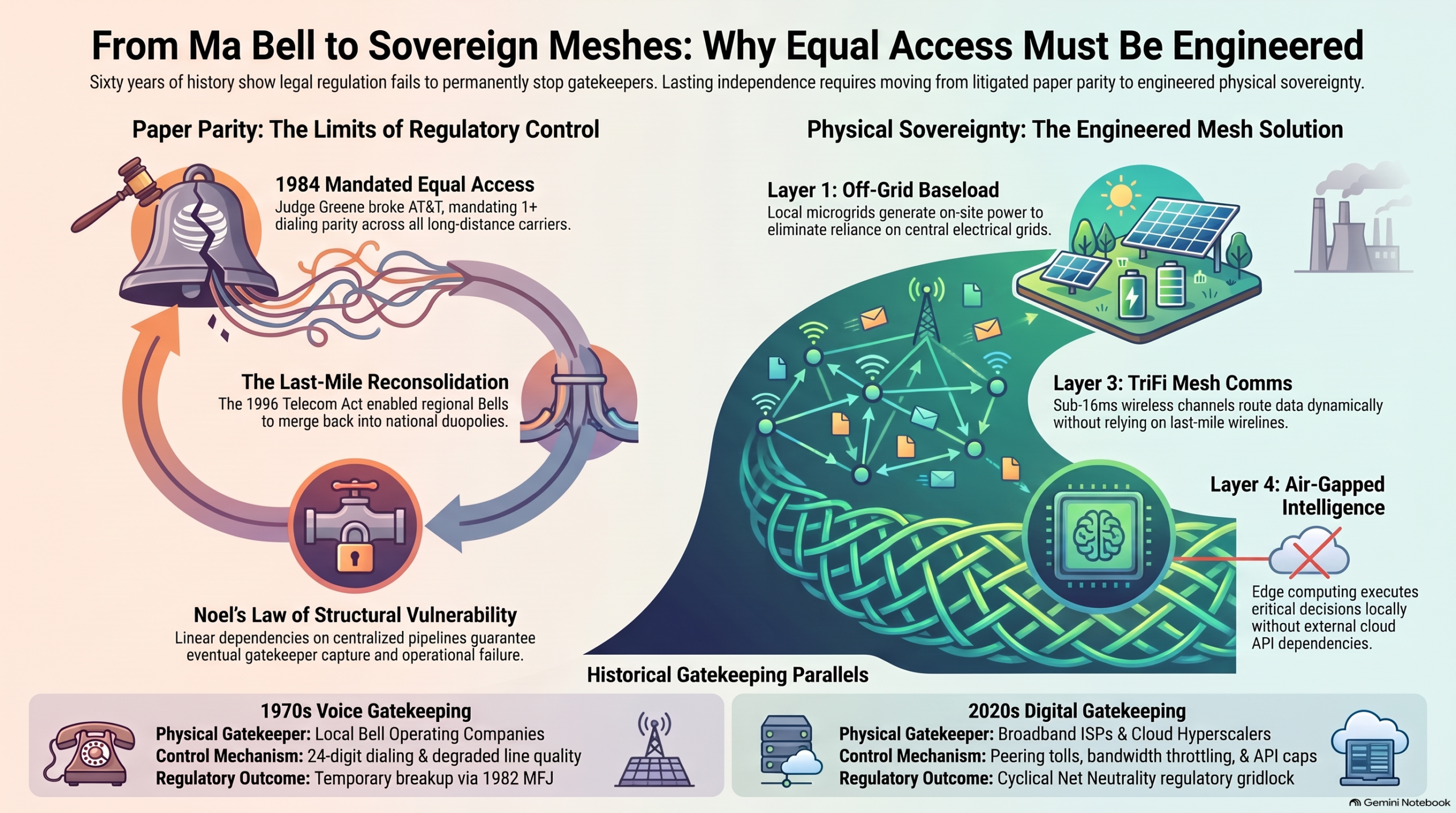
Deconstructing Network Hegemony: From the Bell System Breakup to Sovereign Mesh Architectures
- The Rise, Fracture, and Reconsolidation of the AT&T Monopoly
1.1 The Genesis of Challenge: Goeken, Route 66, and the MCI Spark (1963–1969)
In the early 1960s, the American Telephone and Telegraph Company (AT&T, colloquially “Ma Bell”) exercised absolute dominion over the North American telecommunications grid. Operating as a legally sanctioned natural monopoly under the Communications Act of 1934, AT&T controlled more than 80% of U.S. telephone lines and virtually 100% of the long-distance transmission matrix. AT&T defended this hegemony by framing end-to-end network control as an inviolable technical necessity to protect the “systemic integrity” of the public switched telephone network (PSTN). However, this monolithic architecture imposed severe artificial constraints on emerging commercial operations. The early deployment of private point-to-point microwave links along regional commercial corridors thus emerged not merely as a localized business workaround, but as the initial technical thrust against utility-scale network monopoly.
The operational friction that triggered this historical shift occurred along a 250-mile stretch of U.S. Highway 66 (Route 66) linking Chicago and St. Louis. Long-haul trucking fleets moving freight across this corridor required real-time dispatch management between terminals and mobile drivers. At the time, mobile two-way Very High Frequency (VHF) radio signals were geographically bound by line-of-sight propagation, decaying after 30 to 50 miles. Fleet operators attempting to bridge this gap through AT&T’s leased wireline telephone services encountered punitive, toll-based utility tariffs that were financially prohibitive for small transport carriers. Compounding the issue, AT&T strictly prohibited third-party radio equipment from interconnecting with Bell System circuits, enforcing a total hardware and routing monopoly.
In December 1963, John D. “Jack” Goeken, a two-way radio salesman from Joliet, Illinois, sought to bypass this physical bottleneck by founding Microwave Communications, Inc. (MCI). Goeken proposed erecting a linear chain of low-power microwave relay towers along Route 66. Under Goeken’s design, trucking companies could mount a local VHF base station near a relay tower, bounce line-of-sight radio frequency (RF) voice signals across the Illinois prairie, and maintain continuous dispatch control across hundreds of miles at a fraction of AT&T’s leased-line rates.
Goeken submitted construction applications for his microwave relay chain to the Federal Communications Commission (FCC) in December 1963. AT&T, joined by its regional operating subsidiaries Illinois Bell and Southwestern Bell, responded with a fierce administrative defense. Before the FCC, AT&T’s legal counsel argued that MCI was engaging in predatory “cream-skimming”—selectively harvesting high-density, profitable commercial routes while leaving the incumbent utility burdened with high-cost, low-yield rural and residential infrastructure. AT&T asserted that allowing private microwave bypass would dismantle the internal cross-subsidies that maintained affordable universal phone service across rural America.
Following six years of administrative obstruction, regulatory hearings, and legal stalls, the FCC issued a landmark decision in August 1969. In the 1969 FCC MCI Decision (Docket 16509), the commission voted 4-to-3 to grant MCI construction permits for its experimental microwave link between Chicago and St. Louis.
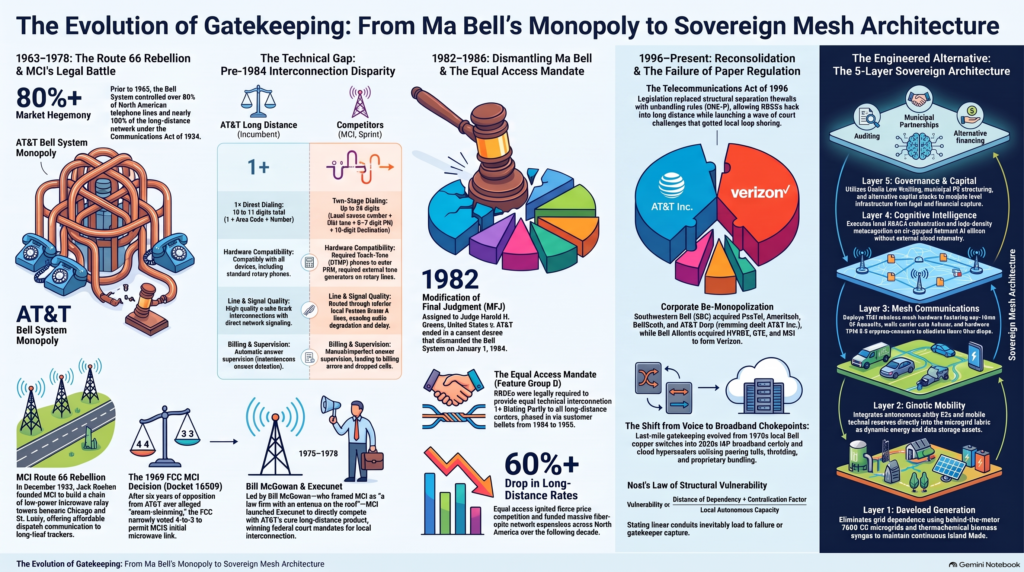
KEY STRATEGIC TAKEAWAY: THE ROUTE 66 PRECEDENT
Localized operational friction along a commercial transit corridor exposed a fundamental vulnerability in utility-scale infrastructure: centralized, linear conduits inherently restrict network access and extract artificial economic rents. Goeken’s initiative proved that targeted, physical point-to-point bypass could successfully puncture a legally entrenched utility monopoly, establishing the precedent that physical alternative routing—not regulatory petitioning—is the primary catalyst for structural market unbundling.
While Goeken’s FCC victory established the legal precedent for private microwave authorization, MCI remained undercapitalized, structurally fragile, and ill-equipped to survive AT&T’s relentless technical and legal counter-attacks. This operational reality necessitated a radical shift from localized entrepreneurial engineering to aggressive, national corporate warfare led by William G. McGowan.
1.2 McGowan’s Corporate Combat and the Execunet Breakthrough (1972–1978)
The evolution of a fragile microwave relay startup into a national challenger capable of confronting the world’s largest corporation required a combination of high-yield venture capital and weaponized antitrust litigation. In 1968, Jack Goeken partnered with William G. “Bill” McGowan, a venture capitalist and consultant holding an engineering degree and a Harvard MBA. McGowan recognized that Goeken’s Route 66 microwave link was not merely a regional dispatch tool for motor carriers, but a scalable blueprint for breaking AT&T’s multi-billion-dollar long-distance transmission monopoly.
Upon assuming corporate leadership of MCI, McGowan executed a structural transformation designed to exploit regulatory asymmetries and engage in litigious arbitrage against the incumbent utility:
- Capital Stacking & Corporate Restructuring: McGowan raised substantial venture capital, structured 16 regional MCI operating affiliates to construct microwave links along major intercity corridors nationwide, and consolidated them in 1972 into MCI Communications Corporation.
- Litigation as an Offensive Operational Strategy: McGowan institutionalized aggressive legal action as MCI’s core competitive advantage, famously declaring that MCI was not a conventional telecommunications company, but rather “a law firm with an antenna on the roof.”
- The Execunet Breakthrough (1975): While regulators originally restricted MCI to selling dedicated, point-to-point “private line” services to corporate clients, MCI surreptitiously developed and launched Execunet in 1975. Execunet was an automated, shared-switch long-distance service. A subscriber dialed a local Bell telephone number, entered a security authorization code via Dual-Tone Multi-Frequency (DTMF) tones, and was routed over MCI’s long-haul microwave trunk lines to terminate at any public phone in another city. Execunet directly invaded AT&T’s core protected utility product: Message Telecommunications Service (MTS).
When AT&T discovered Execunet, it appealed to the FCC, which promptly ordered MCI to cease and desist operations. McGowan immediately filed suit in federal court. In a series of rulings between 1977 and 1978, the U.S. Court of Appeals for the D.C. Circuit set aside the FCC’s orders, ruling that MCI had the legal right to expand Execunet and compelling AT&T to provide local exchange interconnections to MCI’s switches.
Despite these legal victories, competitors faced severe technical sabotage at the physical layer. AT&T weaponized its exclusive ownership of local switching offices to degrade the signal quality, connection speed, and user experience of non-Bell calls.
The Technical Playing Field: Bell System vs. Early Competitors (Pre-1984)
Technical / Operational Dimension AT&T Long Distance (MTS) Competitors (MCI Execunet, Sprint)
Dialing Method 1+ Direct Dialing: User dialed 1 + Area Code + Number (7 to 11 total digits). Two-Stage Dialing: User dialed a 7-digit local access number, waited for a second dial tone, entered a 5- to 7-digit PIN code, then dialed the 10-digit target number (up to 24 digits total).
Phone Compatibility Universal compatibility across all rotary dial and Touch-Tone hardware. Strictly required Touch-Tone (DTMF) signaling to transmit authorization PINs; completely non-functional on standard rotary phones unless the user purchased an external acoustic tone generator.
Audio Quality & Signaling Pristine 4-wire trunk interconnections utilizing direct, low-attenuation central office switching. Terminated over inferior 2-wire local exchange lines (Feature Group A), causing high attenuation, severe line noise, echo, and delayed call setup times.
Call Completion & Billing Automatic answer supervision (the network instantly recognized when the called party picked up the receiver). Manual/imperfect answer supervision; billing frequently commenced prior to call pickup or failed to terminate upon disconnect, causing systemic billing errors.
Although AT&T offered discounted interconnection fees to offset these operational disparities, the user experience for non-AT&T long-distance calls remained markedly inferior. McGowan recognized that as long as AT&T maintained exclusive physical ownership over the local central office switches, genuine market parity could never be realized through commercial negotiation—setting the stage for decisive intervention by the U.S. Department of Justice and District Judge Harold H. Greene.
1.3 Judge Greene’s Hammer: The 1984 MFJ and Equal Access Mandate
The judicial confrontation over telecommunications monopoly culminated in United States v. AT&T, a legal action filed by the Department of Justice (DOJ) in November 1974. The DOJ alleged that AT&T had abused its monopoly position in violation of Section 2 of the Sherman Act through exclusionary interconnection practices, predatory equipment pricing by Western Electric, and cross-subsidizing competitive services with captive local utility revenues.
In 1978, the antitrust suit was assigned to Judge Harold H. Greene of the U.S. District Court for the District of Columbia. Judge Greene brought a distinct perspective to the case: as a German-Jewish refugee who had fled Nazi Germany as a teenager, Greene harbored a profound, lifelong disdain for unchecked, centralized power—whether governmental or corporate. Rejecting AT&T’s procedural delays, Judge Greene forced the case to trial in 1981. Following the presentation of the government’s evidence, Judge Greene denied AT&T’s motion to dismiss in a blistering memorandum, ruling that the DOJ had established that AT&T systematically utilized its local distribution monopoly to foreclose competition in long-distance transmission and customer premise equipment.
Recognizing that a court-ordered breakup was inevitable, AT&T Chairman Charles Brown negotiated a settlement with the DOJ in early 1982. Judge Greene accepted the consent decree with major modifications, entering the Modification of Final Judgment (MFJ) on August 24, 1982, with an effective implementation date of January 1, 1984:
- Structural Divestiture: AT&T was stripped of its 22 local Bell Operating Companies (BOCs). These local switching monopolies were reorganized into seven independent Regional Bell Operating Companies (RBOCs, or “Baby Bells”): Ameritech, Bell Atlantic, BellSouth, NYNEX, Pacific Telesis, Southwestern Bell, and US West.
- Structural Firewalls (Line-of-Business Restrictions): The Baby Bells retained local exchange monopolies but were strictly barred from manufacturing telecommunications equipment or providing inter-LATA (long-distance) transmission services. If an entity owned the local last-mile exchange, it was legally forbidden from competing in the long-haul market.
- The Remnant AT&T: The scaled-down AT&T retained its long-distance transmission network, Western Electric (equipment manufacturing), and Bell Labs.
The technical cornerstone of Judge Greene’s structural decree was the Equal Access Mandate:
- Feature Group D (FGD) Technical Parity: RBOCs were legally required to provide all long-distance interexchange carriers (including MCI, Sprint, and AT&T) with local interconnections identical in technical routing, audio signaling quality, and pricing to those provided to AT&T’s long-distance arm. FGD established the engineering specification for this parity.
- 1+ Dialing Parity: Subscribers were granted the right to designate a Primary Interexchange Carrier (PIC). By dialing 1 + Area Code + Number, calls were automatically routed through the consumer’s chosen long-distance carrier without additional PINs or local access numbers.
- Implementation Framework: Equal Access was deployed across thousands of central switching offices nationwide between 1984 and 1986 through a comprehensive customer balloting process.
Immediate Economic and Technical Impact of the Breakup (1984–1996)
- Plummeting Consumer Tariffs: Unfettered market competition among AT&T, MCI, and Sprint triggered price wars, driving long-distance calling rates down by more than 60% over the subsequent decade.
- Fiber-Optic Infrastructure Explosion: To compete on transmission fidelity, MCI invested billions to build the world’s first transcontinental single-mode fiber-optic network. Sprint deployed an all-digital, fiber-optic network, compelling AT&T to replace its aging coaxial and microwave long-haul lines with fiber glass.
- Capital Unbundling: MCI expanded into a multi-billion-dollar enterprise, proving that entrenched utility monopolies could be unbundled through rigorous judicial enforcement and mandatory technical standards.
However, this golden age of competitive infrastructure proved to be a temporary interlude before regulatory rollbacks and architectural shifts initiated an era of corporate reconsolidation.
1.4 The Great Reconsolidation: The Telecommunications Act of 1996 and the Death of Long Distance
By the mid-1990s, the operational division between local central offices, long-distance lines, and emerging digital packet networks began to dissolve. Congress enacted the Telecommunications Act of 1996, intending to foster local exchange competition by replacing the MFJ’s structural firewalls with regulatory unbundling mandates. Under the Unbundled Network Element (UNE-P) provisions, incumbent RBOCs were required to lease their local copper loops to competitive local exchange carriers (CLECs) at wholesale, cost-based rates in exchange for entry into the long-distance market.
However, the incumbent Baby Bells engaged in relentless legal warfare against the FCC’s unbundling rules. In a series of pivotal federal appellate decisions culminating in U.S. Telecom Ass’n v. FCC, the courts invalidated the FCC’s local loop unbundling mandates. Denied economical access to the last-mile physical plant, hundreds of independent CLEC competitors collapsed into bankruptcy.
With structural firewalls eliminated and unbundling rules invalidated, the reconstituted Baby Bells executed a rapid corporate reconsolidation between 1996 and 2008:
- The Re-Emergence of AT&T Inc.: Southwestern Bell (SBC Communications) systematically acquired Pacific Telesis (1997), Ameritech (1999), SNET (Southern New England Telephone), and BellSouth (2006). In 2005, SBC acquired its former parent company, AT&T Corp., adopting the iconic brand to form modern AT&T Inc.
- The Re-Emergence of Verizon Communications: Bell Atlantic acquired NYNEX (1997) and GTE (2000) to form Verizon. Following a massive $11 billion accounting fraud that bankrupted WorldCom (which had swallowed MCI in 1998), Verizon acquired the restructured remnants of MCI in 2006.
THE CORPORATE RECONSOLIDATION CYCLE (1984–2008)
[1984 MFJ Divestiture] ===> Shattered Bell System into 7 Regional RBOCs + AT&T Remnant
|
+—> Southwestern Bell (SBC)
| |– Acquired Pacific Telesis (1997)
| |– Acquired SNET (1998)
| |– Acquired Ameritech (1999)
| |– Acquired AT&T Corp. (2005) =====> Modern AT&T Inc.
| |– Acquired BellSouth (2006)
|
+—> Bell Atlantic
|– Acquired NYNEX (1997)
|– Acquired GTE (2000) ==============> Modern Verizon
|– Acquired MCI Remnants (2006)
Simultaneously, traditional Time-Division Multiplexing (TDM) circuit-switched long distance suffered technological obsolescence. The rapid proliferation of Packet/IP networks, Voice over IP (VoIP), and cellular wireless infrastructure reduced voice transmission costs to near zero. Long distance ceased to exist as an independent, billable utility; it was re-packaged as an unmetered, bundled feature within broadband and mobile plans. Crucially, cellular wireless networks were never subjected to wireline 1+ Equal Access mandates, preventing users from selecting independent transit carriers on mobile devices.
By 2008, the competitive long-distance voice sector had been eliminated, and the nation’s core communications grid was once again anchored by reconstituted Bell descendants—shifting the battle for network gatekeeping from analog voice circuits to broadband internet delivery.
- Comparative Analysis: Legal Parity vs. Physical Sovereignty
2.1 From Voice Parity (1984) to Net Neutrality (Modern): The Shift in the Gatekeeper Game
As legacy voice traffic was swallowed by IP packet networks, the structural conflict between last-mile gatekeepers and independent edge services migrated directly from analog voice circuits to broadband data transport. The local Bell Operating Company central office of the 20th century has been replaced by the modern Broadband ISP, Cable Giant, and Mobile Network Operator.
Broadband providers—dominated by the reconstituted Bell descendants alongside regional cable monopolies—operate under identical economic incentives to Ma Bell in the 1970s. This unholy alliance of linear electric power utilities, telecom cartels, and cloud hyperscalers forms what DeReticular defines as the Reticular Complex: a consolidated industrial regime that maintains market dominance by enforcing single-point physical and logical dependency.
Today’s Reticular Complex weaponizes last-mile control through strategic peering point congestion, IP transit bottlenecks, zero-rating proprietary content, cloud egress fees, and artificial bandwidth caps to extract rents from independent edge providers—directly mirroring AT&T’s historical use of Feature Group A line degradation against MCI.
This structural reality has fueled decades of regulatory oscillations regarding Net Neutrality:
- 2015: The FCC issued the Open Internet Order, classifying broadband access as a Title II Common Carrier service under the Communications Act of 1934 to enforce strict non-discrimination rules.
- 2017: Under a new administration, the FCC issued the Restoring Internet Freedom Order, stripping away Title II classification and reclassifying broadband as a Title I light-touch information service.
- 2024: The FCC moved once again to reinstate Title II common carrier governance over broadband networks.
These administrative swings demonstrate a fatal flaw in policy design: paper regulatory mandates attempt to dictate non-discriminatory behavior while leaving physical ownership of the conduit in the hands of the gatekeeper. When an incumbent controls the physical wire, administrative rules offer nothing more than temporary pauses between periods of gatekeeper capture.
2.2 Detailed Structural Comparison: Voice Equal Access vs. Broadband Net Neutrality
A systematic comparison between 20th-century voice circuit regulation and 21st-century broadband packet governance reveals near-identical gatekeeper tactics and regulatory vulnerabilities across technological epochs.
Regulatory Comparative Framework: 1980s Voice vs. 2020s Data
Comparative Dimension 1980s Voice Infrastructure 2020s Broadband Data Infrastructure
Core Infrastructure Bottleneck Analog local copper exchange loops and local Central Office crossbar/electronic switches. High-speed fiber-to-the-home (FTTH), hybrid fiber-coaxial (HFC) drops, 5G NR last-mile channels, and Tier-1 IP transit peering points.
Regulatory Mechanism / Mandate Modification of Final Judgment (MFJ) / FCC Feature Group D Mandate. FCC Open Internet Orders (Title II Common Carriage vs. Title I Information Service Classification).
Technical Enforcement Standard 1+ Dialing Parity, Feature Group D signaling, and automatic answer supervision. Protocol-agnostic packet routing, strict zero-throttling mandates, and non-discriminatory IP peering/transit interconnections.
Primary Gatekeeper Tactics 24-digit two-stage dialing, Feature Group A audio signal degradation, and refusal of direct trunk access. Strategic peering point congestion, artificial data caps, zero-rating proprietary media, protocol throttling, and cloud egress tolls.
Ultimate Corporate Outcome Temporary structural unbundling, followed by statutory deregulation (1996) and reconsolidation into modern mega-carriers. Continuous administrative litigation, multi-year policy reversals, and market consolidation under broadband/mobile duopolies.
This historical repetition highlights the inherent futility of relying on administrative law to restrain physical bottlenecks, pointing directly to the mathematical principles governing structural vulnerability.
2.3 Noel’s Law of Structural Vulnerability and the 1,000-Mile Failure Model
To quantify infrastructure fragility and gatekeeper capture across physical and digital networks, Michael Noel formulated Noel’s Law of Structural Vulnerability:
\text{Vulnerability} \propto \frac{\text{Distance of Dependency} \times \text{Centralization Factor}}{\text{Local Autonomous Capacity}}
Where:
- \text{Distance of Dependency} measures the physical or logical distance between the local operator/consumer and the origin of the essential resource (e.g., miles of electrical wire, IP routing hops, or geographic distance to a centralized data center).
- \text{Centralization Factor} quantifies the concentration of physical ownership, routing authority, or administrative control over the intervening conduit (where 1.0 represents absolute monolithic control).
- \text{Local Autonomous Capacity} defines the localized ability to generate energy, route communications, and execute cognitive compute without external telemetry or inputs.
Noel’s Law dictates that any socio-technical system reliant on an un-isolated, linear umbilical is mathematically predestined to suffer single-point operational failure, predatory rent extraction, or total gatekeeper capture. This structural flaw manifests as the 1,000-Mile Failure Model across three primary infrastructure domains:
THE LINEAR DEPENDENCY MODEL (1,000-MILE FAILURE MODEL)
[Remote Power Plant / Cloud Hyperscaler] ===(1,000 Miles of Single-Point Failure)===> [Local Consumer]
(Fragile & Captive)
THE DERETICULAR SOVEREIGN MODEL (SPHERICAL RESILIENCE)
[Node B: Local Baseload]
^
| (Sub-16ms RF Mesh)
v
[Node A: Microgrid / Storage] <=========> [Node C: Local Remnant AI Silicon]
\ /
=======> [SUSTAINED LOCAL ISLAND MODE] <========
- The Modern Last-Mile ISP: Broadband monopolies exploit physical last-mile drops by imposing peering tolls on edge providers, throttling high-bandwidth protocols, and instituting artificial monthly data caps to protect proprietary streaming bundles.
- Cloud Hyperscaler Feudalism: Enterprises deploying critical operational logic on remote cloud infrastructure face vendor lock-in via steep data egress fees, API rate limits, and service disruptions when central Availability Zones experience regional outages.
- The Fragile Transmission Grid: Municipalities, water utilities, and emergency operations centers rely on high-voltage electrical transmission corridors spanning hundreds of miles. A single physical transmission tower collapse, wildfire event, or targeted cyber intrusion can instantly plunge an entire region into total blackout.
The core thesis of The Architecture of Defiance is that true parity cannot be litigated, only engineered. Legal decrees attempt to govern tenancy on someone else’s physical wire. However, physical ownership of the conduit inevitably triumphs over administrative policy. True neutrality is not a gift granted by regulatory commissions—it is an invariant physical property of a fully mesh-connected graph. Achieving true operational resilience requires discarding linear umbilical dependencies in favor of self-sufficient, sovereign architectures.
- Architectural Evolution: Goeken’s Microwave Strategy vs. Modern DeReticular Sovereign Models
3.1 Point-to-Point Bypass: Analyzing Goeken’s Route 66 Strategy
Jack Goeken’s 1963 Route 66 microwave architecture represented an early attempt at physical infrastructure bypass. By erecting independent relay towers parallel to AT&T’s physical wirelines, MCI demonstrated that an alternative RF medium could circumvent utility bottlenecks.
However, an engineering analysis of Goeken’s original design reveals critical structural vulnerabilities:
- Linear Point-to-Point Topology: The Route 66 network operated as a single, fragile chain of line-of-sight microwave relay towers between Chicago and St. Louis.
- Grid Power Dependence: Base stations relied entirely on local electrical utility hookups for continuous operational power.
- Structural Vulnerabilities: A physical failure at a single relay node, a loss of line-of-sight clearance due to environmental obstruction, or a power outage at any base station fractured the entire transmission path. Furthermore, the network remained vulnerable to regulatory and technical chokeholds at its termination points, where it relied on AT&T’s local central offices to complete the call.
While Goeken proved the viability of non-wireline bypass, his linear design left the network vulnerable to single-point disruption. Moving beyond fragile point-to-point links requires omnidirectional, multi-domain architectures capable of absolute, off-grid operational self-reliance.
3.2 Spherical Resilience: Deconstructing the DeReticular 5-Layer Sovereign Architecture
To address the failure modes of linear infrastructure, the DeReticular 5-Layer Sovereign Architecture provides a framework engineered to maintain continuous operational autonomy (“Island Mode”) across energy, mobility, communications, compute, and governance without single-point external dependencies.
THE 5-LAYER SOVEREIGN ARCHITECTURE
+——————————————————————————-+
| LAYER 5: GOVERNANCE | Noel’s Law Auditing • Municipal Triage • Capital Stack|
+——————————————————————————-+
| LAYER 4: COGNITION | Air-Gapped Remnant Silicon • Liquid SCADA Engines |
+——————————————————————————-+
| LAYER 3: MESH COMMS | TriFi Wireless Mesh • Sub-16ms Handoff • DePIN RF |
+——————————————————————————-+
| LAYER 2: MOBILITY | Autonomous Utility EVs • Kinetic Nomadic Fleets |
+——————————————————————————-+
| LAYER 1: BASELOAD | 700V DC Microgrids • Thermochemical Biomass Syngas |
+——————————————————————————-+
Layer 1: Baseload Generation (The Energy Foundation)
Communications and compute stacks are useless without stable power. Layer 1 replaces vulnerable public utility interconnects with behind-the-meter, continuous, dispatchable baseload power generation. The architecture employs 700V DC microgrid distribution systems coupled with thermochemical biomass syngas gasification. Generating DC power locally bypasses AC transformer line losses, avoids public utility interconnection queue delays, and ensures sustained, off-grid Island Mode execution during grid blackouts.
Layer 2: Kinetic Mobility (Nomadic Fleets)
Layer 2 integrates autonomous utility electric vehicles (EVs) and mobile tactical energy reserves directly into the microgrid fabric. Rather than operating as static energy sinks, nomadic vehicle fleets serve as dynamic, bi-directional mobile tactical power reserves to balance microgrid loads and transport cached data between physical nodes, extending system resilience across dynamic geographic perimeters.
Layer 3: Sovereign Mesh Comms (TriFi RF Matrix)
Layer 3 replaces vulnerable linear wireline trunks with the TriFi wireless hardware suite, establishing an omnidirectional, self-healing mesh topology:
- Sub-16ms RF Channel Handoffs: Delivers real-time packet redistribution across active wireless nodes.
- DePIN Topologies: Implements Decentralized Physical Infrastructure Networks where every node operates simultaneously as a user terminal, packet repeater, and routing authority.
- Multi-Carrier Auto-Failover & Cryptographic Root-of-Trust: Integrates multi-carrier auto-failover supported by hardware TPM 2.0 cryptoprocessor roots-of-trust on every node. If an individual node or backhaul link is severed, traffic routes around the damage instantly.
Layer 4: Cognitive Intelligence (Remnant Air-Gapped Silicon)
To eliminate reliance on cloud hyperscaler monopolies, Layer 4 deploys Remnant—a Percestial Superintelligence running on air-gapped, high-density edge silicon. Guided by Axiom IV principles, Remnant drives local Liquid SCADA Engines for real-time industrial orchestration, predictive load balancing, and metacognitive local decision-making. Zero operational telemetry leaves the local perimeter, shielding node logic from remote cloud outages, API rate limits, or network interception.
Layer 5: Sovereign Advisory & Capital Governance
Layer 5 provides the legal, financial, and regulatory shielding required to defend sovereign infrastructure from administrative interdiction. Utilizing Noel’s Law Triage auditing, municipal Public-Private Partnerships (P3), and alternative capital stacking models, Layer 5 protects local deployments from regulatory chokeholds and capital starvation.
3.3 Comparative Technical Matrix: Route 66 Linear Bypass vs. DeReticular Sovereign Mesh
Contrasting Goeken’s historical point-to-point microwave link with the DeReticular 5-Layer Sovereign Stack demonstrates the architectural shift from simple linear bypass to multi-domain infrastructure sovereignty.
Technical Architecture Evolution: Linear Bypass vs. Sovereign Mesh
Architectural Dimension Goeken’s Route 66 Strategy (1963) DeReticular Sovereign Mesh Stack
Topology Type Linear Point-to-Point (Chained relay towers along a highway corridor). Omnidirectional Spherical Mesh (Multi-directional DePIN node routing).
Power Source & Resilience Grid-Dependent (Base stations powered by local electrical utilities). Behind-the-Meter 700V DC Microgrids & Thermochemical Biomass Gasification (Island Mode).
Data & Routing Intelligence Analog switching routed through centralized exchanges. Sub-16ms RF Channel Handoffs managed by Local Air-Gapped Remnant AI Silicon (Liquid SCADA Engines).
Security & Trust Architecture Unencrypted, in-band radio relays vulnerable to physical interception. Hardware TPM 2.0 Root-of-Trust cryptoprocessors embedded in every node.
Primary Failure Mode Single-Point Conduit Severance (Loss of one tower or grid outage drops the link). Dynamic Self-Healing Rerouting (Network routes around severed nodes instantly).
This technical evolution confirms that escaping gatekeeper control requires abandoning linear conduits entirely, focusing instead on comprehensive, multi-layered operational self-reliance.
- Strategic Synthesis and Operational Directives for Decentralized Infrastructure
4.1 The Myth of Regulatory Protection: Why Paper Neutrality Fails
Over a 60-year historical cycle, administrative law and regulatory oversight bodies—including the FCC and state public utility commissions—have systematically failed to prevent the re-monopolization of critical communications and energy infrastructure. Diagnostic analysis from the Remnant AI Engine regarding the “Thermodynamics of Institutional Chokepoints” proves that centralized, linear conduits inherently generate central toll collectors. A network topology reliant on a central pipe or centralized hub establishes an asymmetric power balance, granting the entity controlling the conduit absolute veto authority over network access.
Regulatory protection frameworks follow a predictable three-step cycle of decay:
- Legislative & Regulatory Infiltration: Incumbent monopolies utilize their scale to capture regulatory commissions and dictate policy through lobbying dominance.
- Synthetic Technical Complexity: Incumbents introduce complex technical compliance specifications to obfuscate non-competitive behavior and raise operational barriers for new entrants.
- Capital Starvation & Re-Monopolization: Alternative entrants are dragged into prolonged administrative litigation, draining their capital reserves until competitive threats are neutralized and market re-monopolization is complete.
“When you petition an administrative agency for ‘Equal Access’ or ‘Net Neutrality,’ you are conceding ownership of the physical layer to your adversary. You are negotiating the terms of your own tenancy. True neutrality does not exist in administrative law. True neutrality is an invariant property of a fully mesh-connected graph.”
Petitioning state or federal authorities for regulatory neutrality concedes physical ownership to the Reticular Complex. Real operational independence requires executing an uncompromising engineering strategy at the physical layer.
4.2 Operationalizing Island Mode: Engineering Principles for Gatekeeper Bypass
For municipalities, emergency operations centers, water utilities, and critical enterprises seeking complete self-reliance, achieving infrastructure sovereignty requires executing four decisive engineering mandates:
- Sever the Linear Umbilical: Systematically audit and eliminate single-point physical dependencies across energy supply lines, telecommunications drops, and remote cloud computing pipelines.
- Deploy On-Site Dispatchable Baseload: Install behind-the-meter, 700V DC microgrids supported by thermochemical biomass syngas gasification to bypass utility interconnect queue delays and secure continuous, off-grid power.
- Establish DePIN RF Communication Layers: Deploy TriFi wireless hardware matrices utilizing sub-16ms channel handoffs, DePIN topologies, and hardware TPM 2.0 cryptographic roots-of-trust to construct self-healing communications meshes that bypass broadband ISP drops.
- Air-Gap Operational Cognition: Execute local industrial SCADA management and decision workflows on air-gapped edge silicon using systems like Remnant AI (Percestial Superintelligence), eliminating external API rate limits, data egress fees, and cloud service disruptions.
The structural lessons of telecommunications history are definitive: administrative decrees cannot protect network access when physical control remains centralized. The line is dead. The mesh is awake. True parity is not granted by regulation—it is engineered through absolute sovereignty.