Spherical Resilience: The New Blueprint for Community Independence
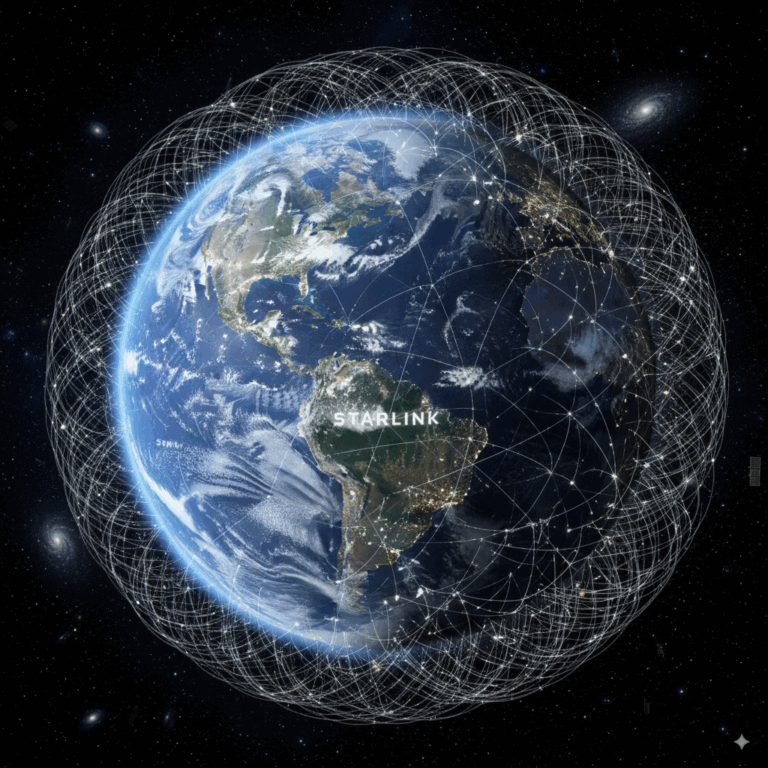
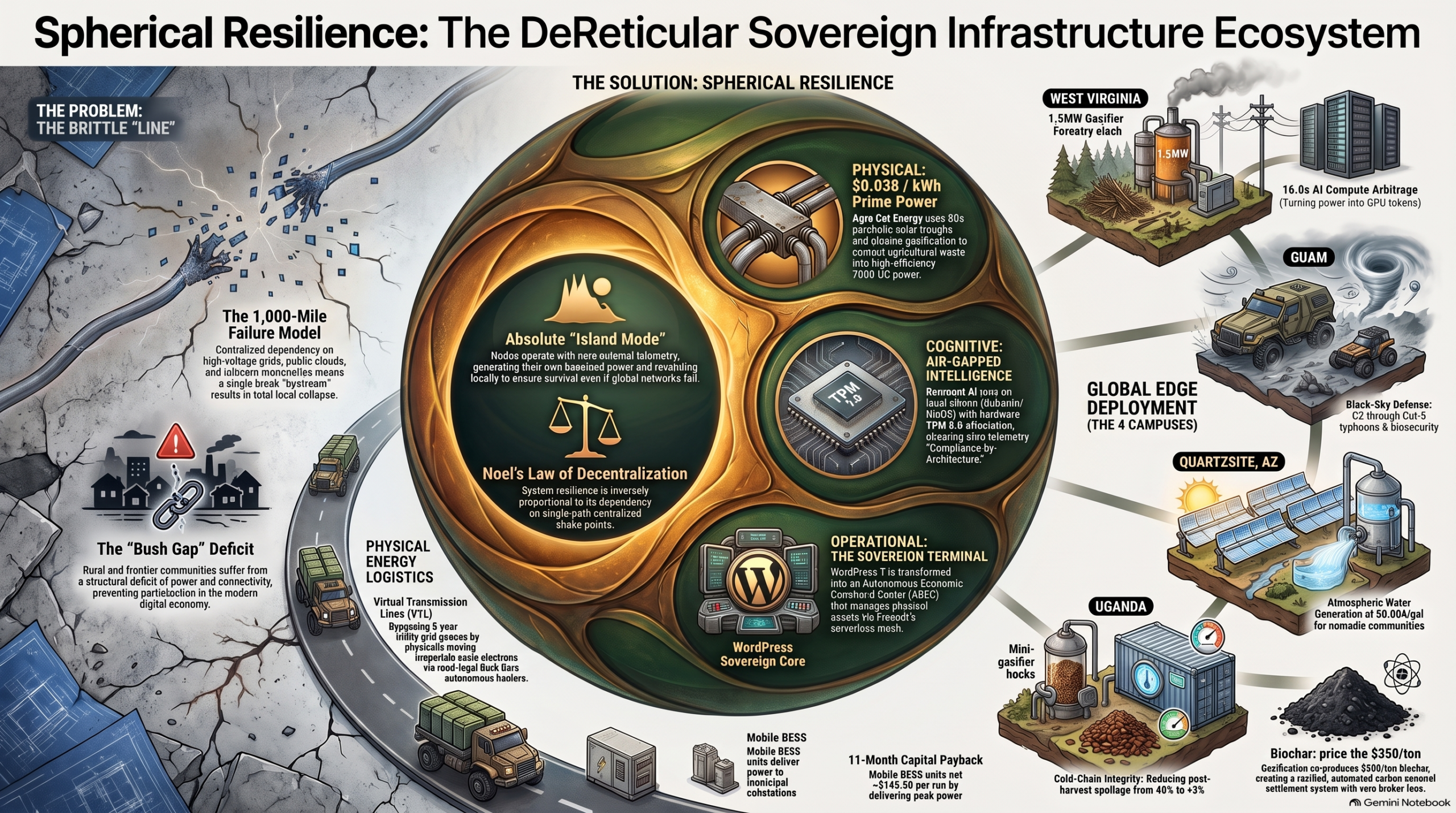
Modern industrial and municipal institutions are currently tethered to “The Line”—a brittle, 1,000-mile failure model defined by centralized power grids, public cloud dependencies, and vulnerable telecom monopolies. When a single tree falls on a transmission line or a distant data center goes dark, entire communities collapse.
The DeReticular ecosystem provides a hardened alternative: Spherical Resilience. This architecture shifts the paradigm from linear fragility to a self-sustaining sovereign node. By decoupling from the reticulum, a community enters “Island Mode,” where its survival is no longer contingent on external infrastructure.
- The Tale of Two Systems: “The Line” vs. “The Sphere”
The central challenge for rural leaders today is the “Bush Gap”—the structural deficit of power and connectivity that prevents local industrialization. Bridging this gap requires moving away from the “network” and toward the “sphere.”
Category Legacy Centralized Model (The Line) DeReticular Sovereign Node (Spherical Resilience)
Energy Source Distant plants via high-voltage grids Behind-the-meter biomass & solar-thermal
Data Storage Centralized public clouds (AWS/Azure) Air-gapped local nodes (NixOS/Kubuntu)
Communication Vulnerable telecom monopolies Serverless P2P mesh (Freenet River)
Failure Impact Cascading Collapse (Regional blackout) Island-Mode Tranquility (Node remains functional)
Synthesis: Noel’s Law of Decentralization “System resilience is inversely proportional to its dependency on single-path centralized choke points; as external dependencies approach zero, local economic survival approaches unity (1.0).”
This transition from dependency to sovereignty is not a mere philosophical shift; it is executed through a precise, interoperable hardware stack.
- The Three Pillars of Sovereignty
Achieving Spherical Resilience requires mastering three layers of infrastructure: Physical, Cognitive, and Operational.
- The Physical Layer (Sovereign Power): The node utilizes Agra Dot Energy thermochemical gasification (converting agricultural waste into syngas) and 80x parabolic solar-thermal troughs. This power is distributed via a 700V DC Common Busbar, which eliminates multiple conversion stages to achieve a 97.7% end-to-end power chain efficiency.
- Sovereign Storage: Energy is stored in Lithium Iron Phosphate (LFP) or Sodium-Ion (Na+) batteries. Sodium-Ion is critical for its thermal resilience, operating from -40°C in Appalachia to 60°C in desert environments without thermal runaway.
- The Cognitive Layer (Sovereign Intelligence): Localized intelligence is handled by the Remnant AI Engine running on dedicated local silicon. This eliminates “prompt leakage” and ensures that a town’s “brain”—used for medical diagnostics or engineering—cannot be censored or disabled by a corporate cloud provider.
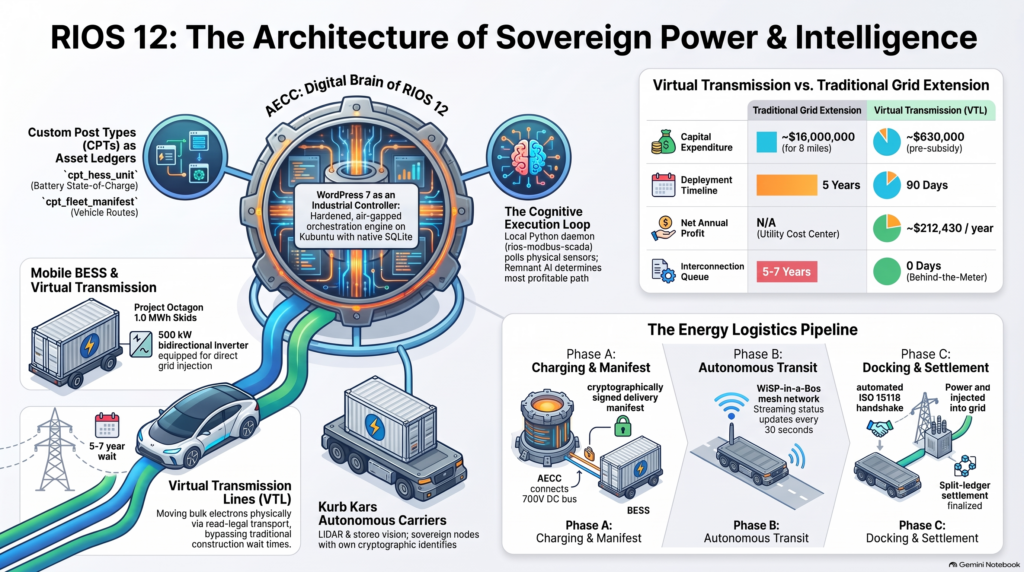
- The Operational Layer (RIOS™ & The Sovereign Terminal): The Rural Infrastructure Operating System (RIOS™) acts as the command core. It uses WordPress 7 not as a website, but as an industrial controller interfacing with SCADA buses. Secure, serverless communication is provided by Freenet River, an end-to-end encrypted (E2EE) P2P mesh.
[DEVELOPER NOTE: THE PRAGMATIC UPGRADE] While the baseline uses Kubuntu and WordPress, the Pragmatic Sovereign Stack is evolving toward NixOS (an immutable, declarative Linux), Zenoh (for sub-millisecond M2M telemetry), and Rust-based engines like PocketBase. For mobility, we prioritize pre-homologated REE Automotive skateboard chassis to bypass the “Automotive Valley of Death.”
- Case Study in Strength: Disaster Resilience and “Black-Sky” Operations
The DeReticular stack is engineered for “Black-Sky” events—scenarios where the commercial grid and national communications have completely severed.
Snapshot 1: The Storm-Hardened Island (Guam) During Pacific super typhoons, the Guam Node activates its Project Octagon storm-hardened skids. While the island grid is blacked out, the node maintains a buried DC microgrid. It utilizes autonomous biosecurity UGVs (Unmanned Ground Vehicles) equipped with thermal-imaging AI to patrol substations. This prevents the Brown Tree Snake from entering transformers—an invasive species that otherwise causes $4.5M in annual grid damage through electrical shorts.
Snapshot 2: The Crisis Clinic In a total communications collapse, the Sovereign Clinical Terminal ensures “Compliance-by-Architecture.” HIPAA requirements are satisfied via TPM 2.0 hardware sealing and Zero-Knowledge Proofs (ZKPs), rather than paper BAAs. The terminal coordinates autonomous medical drones to deliver cold-chain biologics, using local Remnant AI to manage triage when the “Line” to the outside world is dead.
- The Economics of Independence: Bypassing “The Line”
Sovereignty is a financial strategy. By utilizing West Virginia H.B. 2014 (The Power Generation and Consumption Act), nodes can be certified as Certified Microgrid Districts, legally bypassing Public Service Commission rate regulation and 5–7 year utility interconnection queues.
- Virtual Transmission Lines (VTL): Communities bypass grid bottlenecks by moving electrons over roads. Kurb Kars autonomous haulers move Mobile BESS units (1.0 MWh) from generation sites to local substations.
- The $0.038/kWh Advantage: Behind-the-meter prime power from Agra Dot Energy allows for ultra-low-cost industrial operations that are immune to utility price hikes.
- AI Compute Arbitrage: By turning extra power into local AI compute, communities achieve a 16.6x economic expansion factor. This converts a 0.06/kWh wholesale export price into ~1.00/kWh of local AI token value.
Capital Engineering: The Non-Dilutive Flywheel Rural leaders can offset up to 97% of the cost by “stacking” specific grants:
- USDA REAP: For agricultural biomass gasification.
- FEMA BRIC: For emergency resilient infrastructure.
- IRS Section 6417 (Direct Pay): Allows non-profits and municipalities to receive direct cash refunds for clean-energy CapEx.
- Conclusion: Stepping Off the Reticulum
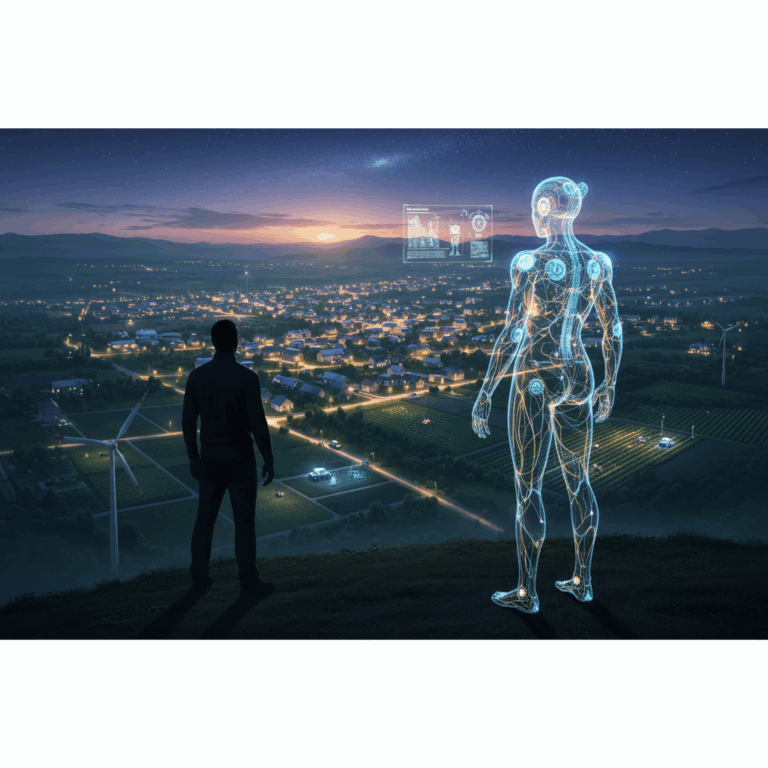
The ultimate vision of Hero 12 is a stark juxtaposition: on one side, the chaotic, sparking failure of “The Line”; on the other, the tranquil, illuminated Sovereign Node. By adopting RIOS™, rural communities are no longer endpoints of a fragile network; they are the center of their own self-sustaining universe.
[HUD TELEMETRY: SOVEREIGN TERMINAL]
- BUS_VOLTAGE: 700.2V DC [NOMINAL]
- BESS_SOC: 94.2% [LFP/Na+ HYBRID]
- MESH_STATUS: FREENET_RIVER [E2EE_ACTIVE]
- COMPUTE_YIELD: $0.98/kWh [REMNANT_V3]
Learner’s Final Insight
- From Fragility to Anti-Fragility: Spherical Resilience eliminates the cascading risks of the 1,000-mile failure model.
- Compliance-by-Architecture: Security and privacy are enforced by hardware (TPM 2.0/ZKPs), not just paperwork.
- Economic Freedom: Turning local waste into $0.038/kWh power and $1.00/kWh AI compute creates a foundation for a new century of rural prosperity.
DeReticular is the Rural Infrastructure Operating System—the blueprint for a future defined by local power, local intelligence, and absolute community freedom.