The Ledger of Two Worlds: A Guide to Secure Data Sovereignty
1. The Modern Privacy Paradox: Why We Can’t Just “Trust” the Cloud
In our current digital era, organizations are trapped in a “Privacy Paradox.” To survive, they must harness the cognitive power of hyperscale Artificial Intelligence. Yet, the data required to fuel these models—medical records, intellectual property, and private identities—is precisely what they are legally and ethically mandated to keep secret.
For decades, we have attempted to bridge this gap using “Administrative Promises.” This is the comforting, yet dangerous, belief that a signed contract or a Terms of Service (ToS) agreement creates a technical wall. In a system architect’s eyes, this is a fatal flaw.
[!IMPORTANT] The Trusted Environment Fallacy This is the assumption that “soft” barriers—legal agreements, Business Associate Agreements (BAAs), or zero-retention policies—provide a physical defense against data leakage. In reality, legal promises do not prevent technical exfiltration; they merely provide a venue for litigation after the vault has been breached.
When raw data leaves your premises for a centralized cloud, it faces three primary “threats to the vault”:
- Subpoena and Jurisdictional Compulsion: Under laws like the CLOUD Act, providers can be forced to decrypt and hand over data without your knowledge.
- Hypervisor Compromise: Rogue administrators or microarchitectural exploits (like those targeting secure enclaves) can allow an adversary to peek at data while it is being processed.
- Inference Attacks: Malicious actors can use “prompt injection” to trick an AI into revealing sensitive PII it encountered during previous processing sessions.
Because these soft promises eventually fail, we must move away from administrative trust and toward Physical Sovereignty.
podcast
2. Meet the Sovereign Gateway: The Guard at the Gate
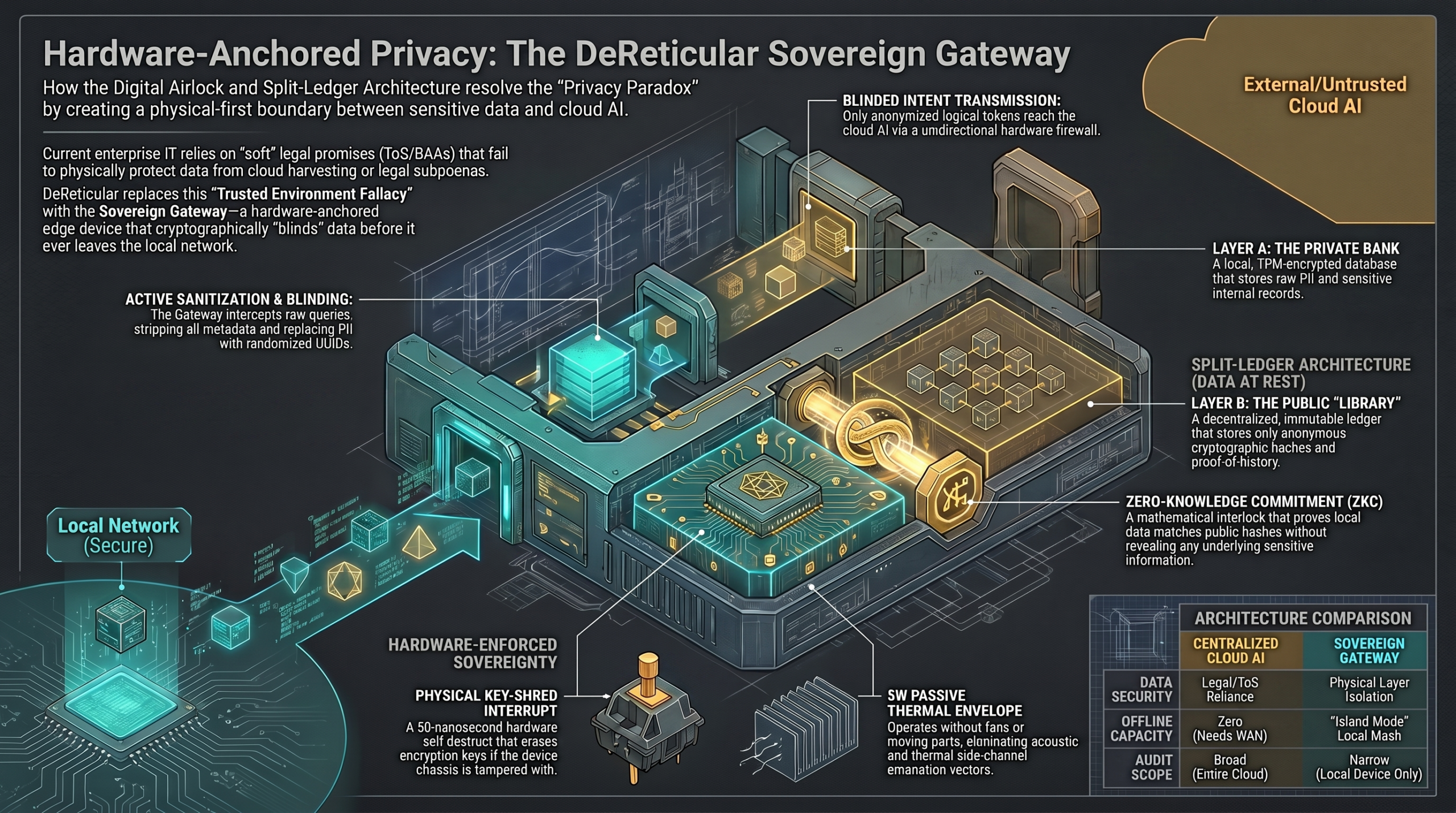
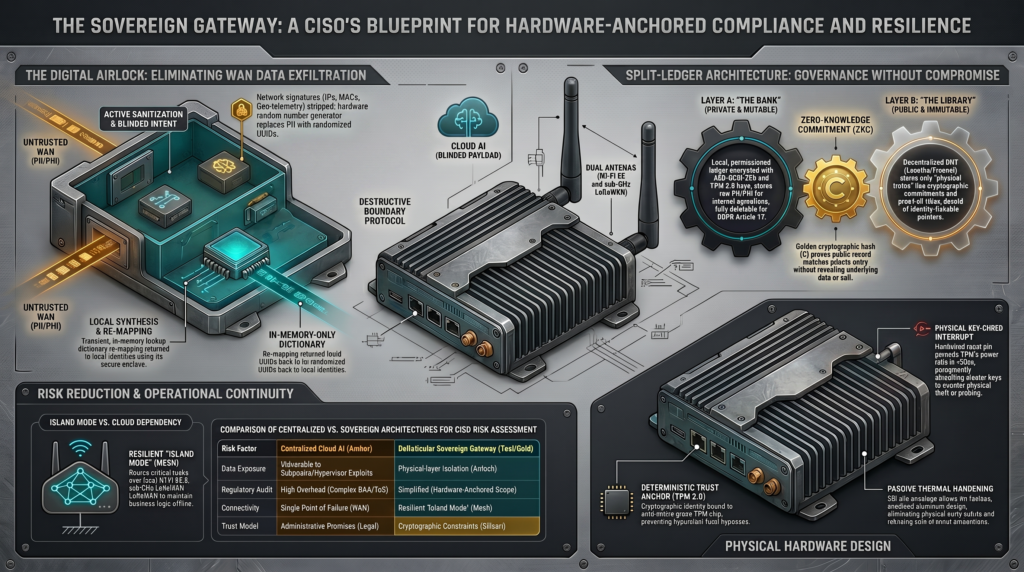
The Sovereign Gateway is not merely a computer; it is a “Physical-First” barrier. Built on the Premium Silicon Sentry architecture using the Apple M4 System-on-Chip (SoC), it utilizes the M4 Neural Engine for local reasoning. By restricting the hardware to a 5W power envelope, the system uses passive thermal dissipation—no fans, no moving parts, and no “acoustic side-channels” for hackers to exploit.
The device runs on the Rural Infrastructure Operating System (RIOS), a hardened distribution designed for absolute local autonomy.
| Dimension | Standard Cloud AI | The Sovereign Gateway |
| Upfront Cost | Zero hardware cost; high operational fees. | Capital expenditure for dedicated hardware. |
| Privacy/Security | Data harvesting as an architectural feature. | Hardware-anchored (TPM 2.0) isolation. |
| Connectivity | Requires constant, vulnerable WAN. | Island Mode: Operates via local LoRaWAN mesh. |
| Audit Scope | Broad (includes cloud provider). | Scope Reduction: Limits audit to local hardware. |
The “Key-Shredding” Interrupt
To protect against physical theft, the Gateway treats its encryption keys like a “Self-Destructing Message.” A physical reset pin and chassis-intrusion sensors are hardwired to the TPM 2.0 chip’s power rails. If the device is tampered with, a hardware interrupt triggers, pulling the voltage to ground and shredding the master keys in under 50 nanoseconds.
To prevent accidental data loss from this “destructive defense,” the system utilizes M-of-N Cryptographic Sharding (Shamir’s Secret Sharing). Master backup keys are split into multiple physical fragments (shards) distributed among trusted trustees, ensuring that a quorum is required to restore the system.
3. The Digital Airlock: Cleaning Data for the Outside World
The Digital Airlock protocol acts as a decontamination chamber. It ensures that sensitive identities never cross the network boundary by performing a destructive translation of your data.
The process follows a strict 4-step sequence:
- Intercept: The Sovereign Executive Agent catches the raw query at the socket layer. The data is held in volatile memory (RAM) within a secure enclave and never touches the permanent SSD.
- Sanitize: The Active Sanitization Engine programmatically strips metadata, including IP addresses, GPS coordinates, and device fingerprints.
- Blind: The Blinded Intent Generator replaces PII with randomized UUIDs. These mappings are stored in a transient “State Translation Engine” dictionary that exists only for the lifetime of the transaction.
- Transmit: The “Blinded Intent” is serialized into a structured schema and passed through a physical-level firewall to the cloud.
Before and After: The Airlock in Action
The State Translation Engine ensures the AI receives the logic without the identity.
Raw Query (Staged in Local RAM): "Check medical files of Patient Alice Smith (ID: 98122) for abnormalities in drug X."
Blinded Intent Payload (Sent to Cloud via Protobuf/JSON):
{
  "intent": "evaluate_interaction",
  "subject_id": "UUID-8812-44X",
  "substance_id": "UUID-9901-22B",
  "context": "clinical_history_analysis"
}
Once the cloud returns a result, the State Translation Engine re-maps the UUIDs back to “Alice Smith” locally. The outside world sees the logic; only you see the names.
4. The Bank (Layer A): The Vault of Secrets
“The Bank” is the private, local authority of the system. It is the only place where “Real Names” and sensitive identities live.
The Rules of The Bank:
- Private and Permissioned: Access is restricted to local authorized operators.
- TPM-Encrypted: Every record is locked using keys physically generated by the hardware security chip.
- Mutable and Erasable: Records can be deleted to satisfy the GDPR “Right to be Forgotten.”
Because the Bank is mutable, deleting a record here renders any corresponding data in the outside world permanently anonymous. Once the identity link is gone, the “Blinded Intent” can never be re-associated with a human being.
5. The Library (Layer B): The Public Proof of Truth
While the Bank holds secrets, “The Library” (Layer B) holds the evidence. Built on the Locutus/Freenet decentralized network, this is where “Physical Truths” live.
Comparison Card:
- The Bank: Stores PII, PHI, and Trade Secrets (e.g., “Alice Smith bought 10 tons of grain”).
- The Library: Stores Hashes, Metrics, and Timestamps (e.g., “A valid transaction occurred at 10:00 AM”).
Truth in the Library is governed by WebAssembly (Wasm) contracts. These are immutable pieces of code that define how data can be updated. This ensures the Library is a “Small-World” map where anyone can verify that a transaction happened, but no one can “unmask” who was involved.
6. The Golden Link: Zero-Knowledge Commitments (ZKC)
To connect the private Bank to the public Library without leaking data, we use the Zero-Knowledge Commitment (ZKC). Think of this as Two Interlocking Gears: the solid, private gear (Bank) and the transparent, public gear (Library). They only mesh at a single point: the Commitment.
Mathematically, the Gateway generates a hash of the secret data combined with a random “salt”: Commitment C = Hash(Data + Secret Salt)
The “So What?” of ZKC: This allows a global distributor to verify that a “Physical Truth” (like a carbon credit or a shipment) is valid by checking the Wasm contract in the Library. They verify the contractual truth, not the identity of the participants. The Gateway proves the Bank record matches the Library record without ever showing the “Secret Salt” or the underlying PII.
7. Conclusion: The Sovereign Advantage
The shift from “Administrative Promises” to “Physical Constraints” represents the ultimate evolution of digital trust. By implementing the Sovereign Gateway and the Split-Ledger architecture, organizations gain three definitive advantages:
- Regulatory Scope Reduction: Because PII never leaves the Gateway, the external cloud provider is removed from the legal scope of HIPAA or GDPR audits, drastically lowering compliance costs.
- Operational Resilience: In Island Mode, RIOS routes traffic through a local mesh network, allowing core functions to continue even if the regional internet is severed.
- Mathematical Sovereignty: You no longer need to “trust” a provider’s privacy policy. You rely on the laws of physics and the certainty of mathematics.
Key Takeaways
- [ ] Hardware is the Root: Security is anchored in a physical TPM 2.0 chip and M4 silicon.
- [ ] RAM-Only Processing: The Digital Airlock stages data in volatile memory, never touching the SSD.
- [ ] The Split is Law: Keep identities in the Bank (Layer A) and proofs in the Library (Layer B).
- [ ] Wasm Governs Truth: Layer B uses WebAssembly contracts to ensure immutable, public verification.
- [ ] Fail-Safe Recovery: Use M-of-N Sharding to protect against the “Key-Shredding” defense.