
Implementation Roadmap: Transitioning to Spherically Resilient Municipal Infrastructure
1. The Strategic Imperative: Moving Beyond Linear Fragility
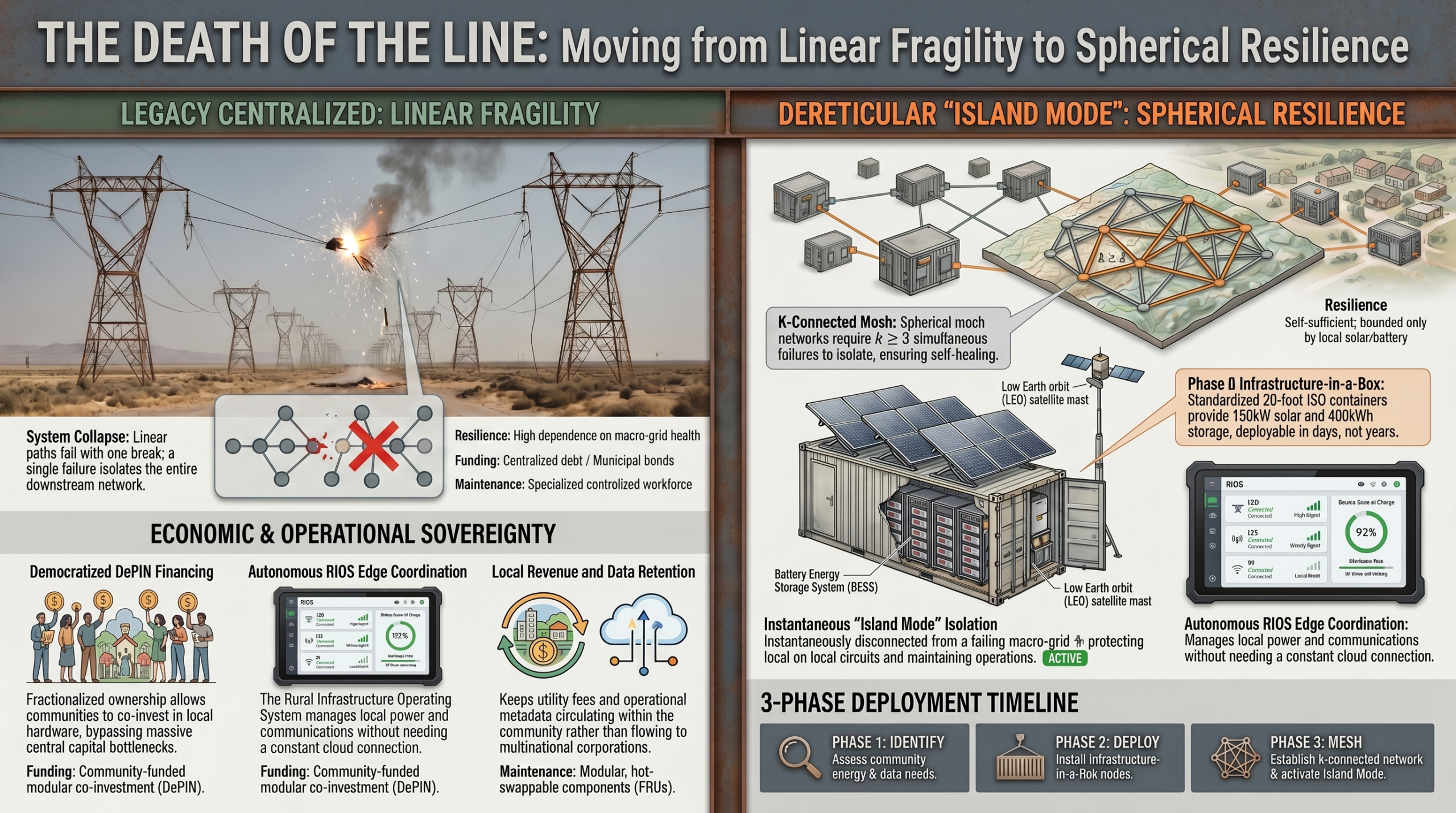
Modern municipal infrastructure is currently defined by a historical design choice: “Linear Fragility.” For over a century, regional planning has centered on high-capacity, centralized corridors—such as high-voltage transmission lines and single-source fiber-optic backbones—to deliver services. While efficient under stable conditions, this model exposes society to systemic collapses where a single physical disruption or digital breach cascades downstream. Transitioning to “Spherical Resilience” is a strategic necessity to protect critical services against weather anomalies, cyber-physical sabotage, and supply chain fragmentation.
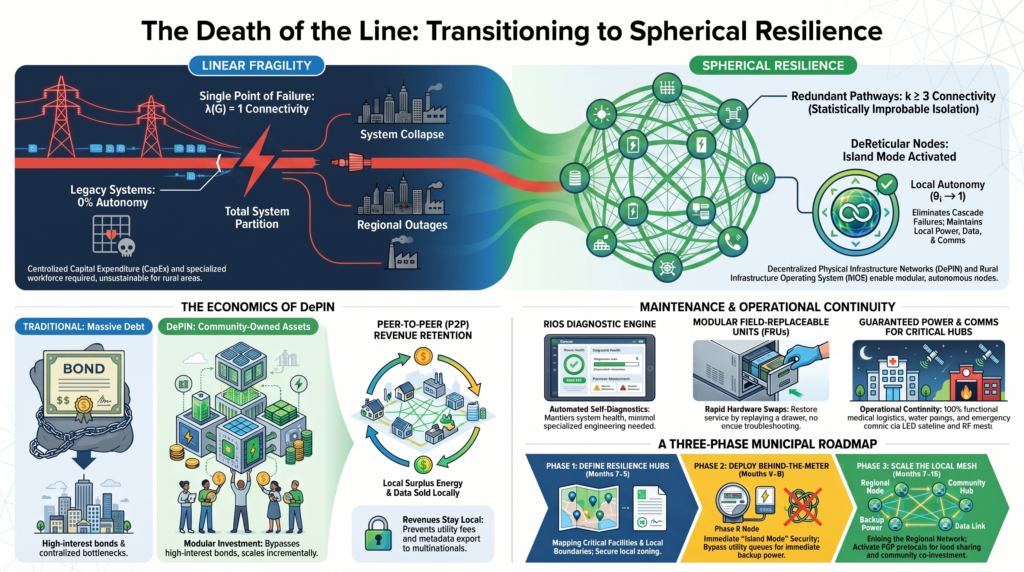
The difference between these models is quantified through graph theory. Traditional linear or tree topologies have an edge connectivity of one (\lambda(G) = 1), where the probability of a systemic partition event under a random link failure rate p is calculated as P_{\text{partition}} = 1 – (1 – p)^{|E|}. As the geographical scale (|E|) grows, the probability of system collapse approaches 1. In contrast, “Spherical Resilience” utilizes k-connected mesh architectures where k \ge 3. In this structure, the probability of any node becoming isolated is drastically reduced to P_{\text{isolation}} = \prod p_j. Every node maintains multiple redundant pathways, requiring the simultaneous failure of at least k independent paths to trigger an outage.
podcast
The core functional goal of this transition is the “Island Mode” capability. By setting the autonomy factor to approach one (\theta_i \to 1), a municipal node can automatically isolate its local electrical and data systems using solid-state transfer switches. This eliminates external dependencies and prevents the propagation of cascade failures, ensuring critical services remain operational even when the surrounding territory is dark.
As we move from theoretical frameworks to practical implementation, we must evaluate the specific structural gaps between current legacy systems and a resilient mesh.
video
2. Gap Analysis and Strategic Baselines
A rigorous gap analysis is the prerequisite for any infrastructure migration. Understanding the delta between “Legacy Baselines” and “Spherical Resilience” informs procurement and policy, allowing planners to identify where decentralized interventions can bypass entrenched utility bottlenecks.
The Structural Gap Matrix
| Dimension / Pillar | Current State (Legacy Baseline) | Desired Future State (Spherical Resilience) | DeReticular System Interventions |
| Grid Topology | Linear/Tree configuration; single point of failure. | K-connected, decentralized microgrids with “Island Mode.” | Deploy Phase 0 nodes Behind-The-Meter (BTM) for local isolation. |
| Telecommunications | Single-path fiber; vulnerable to physical cuts. | P2P localized mesh routing over multiple physical layers. | RIOS Signal Fusion to route traffic over LEO, LTE, and RF mesh. |
| Asset Finance | Centralized utility bonds; multi-decade debt. | Modular, community-funded assets; fractionalized ownership. | Leverage DePIN and Microgrid-as-a-Service (MaaS) for CapEx substitution. |
| Regulatory Compliance | Lengthy interconnection queues; strict PUC oversight. | Flexible governance; expedited interconnection (e.g., AB2175). | Use UL 1741/IEEE 1547 compliant systems to bypass study queues. |
| Operational Capacity | Reliance on specialized, centralized utility technicians. | Self-healing autonomous operations; modular maintenance. | Standardize hardware with RIOS diagnostics and hot-swappable FRUs. |
Evaluating Regulatory and Administrative Obstacles
The primary obstacle to rapid resilience is the “Interconnection Gap.” Investor-owned utilities (IOUs) often impose multi-year study queues for grid-tied systems. Furthermore, archaic codes often classify multi-customer microgrids as “electrical corporations,” subjecting them to heavy oversight. To bypass this, we utilize a “Behind-The-Meter” (BTM) strategy. By installing nodes at municipal service points, facilities gain immediate “Island Mode” capability. This strategy leverages emerging policies like California’s AB2175, which provides exemptions for microgrids serving localized loads from strict Public Utility Commission (PUC) status.
Skill Deficit Assessment
The “Technical Skills & Maintenance Gap” is acute in rural areas. The Rural Infrastructure Operating System (RIOS) mitigates this through a hardware-agnostic driver architecture that integrates with legacy industrial protocols—specifically Modbus, CAN bus, and DNP3—out of the box. Physical hardware is designed as field-replaceable units (FRUs), allowing local operators to maintain systems via modular swaps rather than complex onsite troubleshooting.
Closing these gaps requires a phased approach that balances immediate resiliency with long-term regional scalability.
3. Phase 1: Strategic Identification and Resilience Hub Mapping
Phase 1 defines regional “Resilience Hubs,” ensuring that initial capital is deployed for maximum public safety impact. Identifying critical nodes such as water pumps, emergency shelters, and comms towers ensures that the community’s “life-support” systems are the first to be hardened.
Feasibility and Permitting Actions (Months 1–3)
- Map Regional Critical Facilities: Prioritize sites where failure triggers secondary health or safety crises (e.g., water treatment).
- Identify Legacy Interconnection Points: Locate facility service points for BTM integration to bypass export study queues.
- Regulatory Boundary Mapping: Confirm eligibility for AB2175 or similar microgrid roadmap exemptions.
- Zoning and Foundation Prep: Obtain permits for 20-foot ISO footprints. Foundations must be rated for a 25,000 lbs (approx. 11,300 kg) loaded weight using concrete pads or screw-piles.
Resource Prioritization
Facilities requiring “Island Mode” priority are the anchors of regional stability. By securing these hubs first, a municipality creates sovereign islands capable of sustaining operations during a “System Collapse” event before the wider mesh is fully linked.
Once hubs are mapped and foundations set, the physical deployment of hardware can begin without waiting for macro-grid upgrades.
4. Phase 2: Deploying “Phase 0” Infrastructure-in-a-Box
The strategic advantage of “Phase 0” is rapid commissioning—moving from delivery to “Island Mode” in days rather than years. This “Infrastructure-in-a-Box” provides immediate local resilience while serving as the seed for the future mesh.
Technical Specifications of the Node
Each node is housed in a 20-foot ISO High-Cube container with the following specifications:
- 150 kW Solar Array: Bifacial monocrystalline arrays utilizing a mechanical scissor-jack system for rapid deployment and protection during transit.
- 400 kWh LiFePO4 BESS: Chosen for thermal stability and a >6,000 cycle lifespan. Includes liquid-loop thermal management and automated aerosol fire suppression.
- 30 kW Hydrogen-Ready Auxiliary Generator: Provides baseload support during extended low-solar periods.
- RIOS Edge Compute Cluster: An IP67-rated, three-node high-availability cluster serving as the system “brain.”
The Behind-The-Meter (BTM) Bridge
The BTM strategy allows for immediate commissioning by installing the node behind the existing utility meter. During grid anomalies, the node triggers a solid-state transfer switch to enter “Island Mode.” This allows the facility to maintain operations while bypassing the multi-year utility connection studies required for systems that export power to the macro-grid.
5. Phase 3: Scaling the Local Mesh and P2P Integration
Phase 3 transitions individual nodes into a networked regional ecosystem. Activating DeReticular Mesh Network protocols (Babel/OLSRv2) transforms modular units into a k-connected ecosystem.
Orchestration via RIOS
RIOS manages the complex task of “Signal Fusion” and “Autonomous Machine Coordination (AMC).”
- Consensus Mechanisms: RIOS utilizes Raft or PBFT (Practical Byzantine Fault Tolerance) localized consensus, allowing nodes to agree on system state and resource allocation while fully air-gapped.
- Functional Outcomes: The AMC maintains critical industrial controls, such as water pumping, and supports intranodal telephony and municipal database synchronization even during a total national backhaul or internet blackout.
Achieving Regional Redundancy (Months 7–18)
By linking adjacent nodes, the system achieves “Spherical” redundancy. If one node’s primary LEO or LTE uplink is severed, RIOS automatically reroutes telemetry and data through the mesh to a neighboring node with an active link. This self-healing structure ensures that regional emergency dispatch and communications remain uninterrupted.
6. Economic Framework: DePIN and Microgrid-as-a-Service (MaaS)
The transition relies on a shift from centralized CapEx to decentralized, community-driven financing. DePIN (Decentralized Physical Infrastructure Network) economics eliminate the central planning bottlenecks that traditionally deprioritize rural areas.
The MaaS Financing Model
Rather than high-interest municipal bonds, the “Microgrid-as-a-Service” (MaaS) model facilitates CapEx-to-OpEx substitution. Local cooperatives or institutional investors purchase the hardware and lease it to the municipality via capacity service contracts. This allows communities to pay a predictable fee—often lower than legacy utility costs—while avoiding massive upfront capital outlays.
Revenue and Data Sovereignty
By retaining local utility fees and metadata, the municipality ensures economic value remains within regional borders. Peer-to-peer (P2P) energy trading within the mesh allows for the monetization of surplus generation, further subsidizing the cost of the infrastructure.
7. Operational Blueprint and Risk Mitigation (SWOT Synthesis)
Strategic success requires managing regulatory pushback and supply chain volatility through a proactive mitigation framework.
Strategic Synthesis & Mitigation Framework
| Key Challenge | DeReticular Action Plan |
| High Initial CapEx | Utilize DePIN co-investment models; leverage MaaS for CapEx-to-OpEx substitution. |
| Technical Skill Deficit | Standardize on RIOS with remote OTA diagnostics; utilize modular, hot-swappable FRUs for maintenance. |
| Regulatory Monopoly Pushback | Deploy initially as BTM off-grid backup systems to bypass interconnection delays; cite AB2175 for exemptions. |
| Supply Chain Volatility | Maintain a chemistry-agnostic chassis (e.g., sodium-ion compatible) to dampen mineral volatility risks. |
Maintenance and Compliance Standards
Nodes must adhere to IEEE 1547 (interconnection) and UL 1741 (safe grid disconnection) standards. Operational health is maintained through a biannual schedule including BESS testing, solar cleaning, and fire suppression verification.
The transformation of municipal infrastructure from “Fragile Lines” to Sovereign Islands of Resilience ensures that communities are architecturally prepared to thrive through systemic disruptions.