Briefing Document: The Sovereign Helping Hand (SOV-ROBO-HAND)
Executive Summary
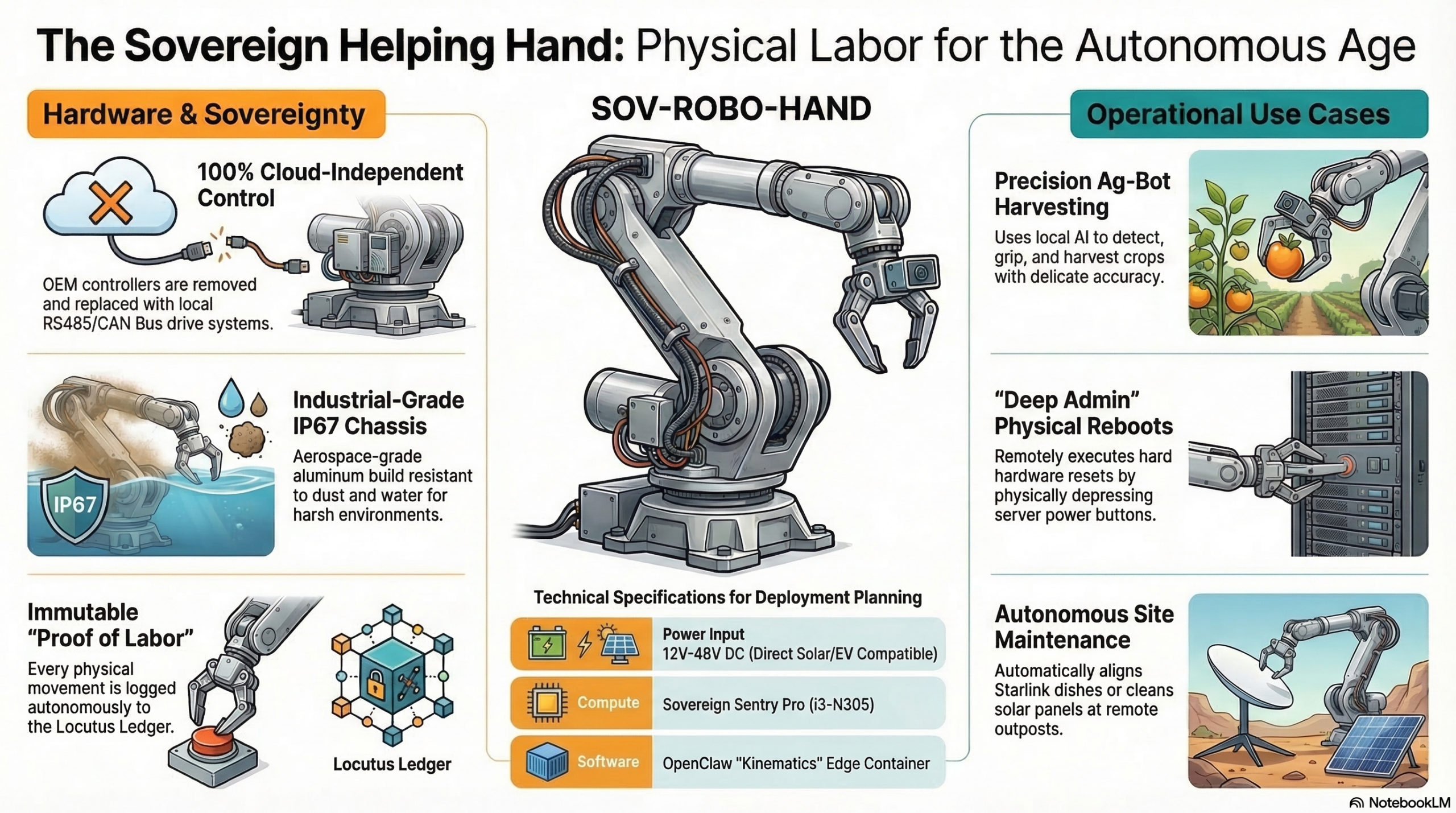
The Sovereign Helping Hand (SOV-ROBO-HAND) is an industrial-grade, 6-axis robotic manipulator developed by DeReticular’s Robotics & Cybernetics Division. Designed to bridge the gap between digital sovereignty and physical labor, the device is an IP67-rated mechanism that operates entirely without proprietary, cloud-tethered firmware. By replacing original equipment manufacturer (OEM) controllers with a ruggedized DC-drive system, DeReticular ensures that the hardware remains 100% locally controlled via the OpenClaw “Foreman” agent.
Positioned at an MSRP of $2,899.00, the Helping Hand is intended for autonomous farming, hazardous material handling, and remote infrastructure maintenance. Its primary value proposition lies in its “Proof of Labor” capability, where every physical movement is logged to the Locutus Ledger, ensuring a transparent and verifiable record of autonomous activity. The system requires a Sovereign Sentry (Pro) or Nomad Fleet Kit for inverse kinematics compute and control.
——————————————————————————–
1. Product Identity and Technical Specifications
The Sovereign Helping Hand is a specialized physical manipulator designed for high-stakes, off-grid, or sovereign environments.
1.1 Hardware Specifications (The “Muscle”)
- Chassis: 6-axis robotic arm constructed from aerospace-grade aluminum.
- Durability: IP67-rated for dust and water resistance.
- Actuators: High-torque brushless DC motors equipped with absolute magnetic encoders to retain positional awareness during power loss.
- Power Input: 12V-48V DC direct input, compatible with solar charge controllers and electric vehicle (EV) buses. It contains no internal lithium-ion batteries, eliminating risks of swelling or fire.
- Communication: RS485 / CAN Bus for zero-latency communication with the host Sentry Node.
- End-Effectors: Includes a high-friction 2-finger parallel gripper as standard. Optional attachments include precision tweezers, macro-camera mounts, and soldering irons.
1.2 Software Infrastructure (The “Motor Cortex”)
The system relies on a local compute stack rather than cloud-based processing:
- OpenClaw Kinematics: A local image (
dereticular/openclaw-robotics:latest) running an Inverse Kinematics (IK) solver on the Sovereign Sentry Pro’s i3-N305 processor. - Vision-to-Grip API: A secure container bridging the arm with LiDAR or camera feeds from the Vault Warden or HempGrade AI stacks.
- Local Control: The arm is “deaf and blind” to the cloud, responding only to commands from a paired DeReticular Node.
2. Manufacturing and Deployment Workflow
DeReticular utilizes a unique “retrofitting” process to ensure the hardware meets its sovereign standards.
2.1 Fulfillment and The “Brainwashing” Process
- Procurement: Base 6-axis robotic arms are sourced from Shenzhen OEMs.
- De-coring: Technicians physically remove (“gut”) the OEM Wi-Fi and cloud controller boards.
- Retrofitting: A DeReticular RS485 adapter is soldered directly to the motor driver bus. This ensures the hardware cannot be accessed by the original manufacturer or any external cloud service.
2.2 User-Side Installation
The installation process is designed for modularity and stability:
- Mounting: The arm is bolted to a stable surface, such as a workbench, agricultural rover, or Kurb Kar bed.
- Integration: The user connects the arm’s DC input to a battery bank and runs the data cable to a Sovereign Sentry or Nomad Link.
- Calibration: Users initiate a Kinematics Calibration sequence via their Sentry dashboard using a Sovereign Key.
——————————————————————————–
3. Operational Capabilities and Use Cases
The Helping Hand is engineered for three primary autonomous and semi-autonomous roles.
3.1 Autonomous Agricultural Harvesting
Integrating with the Nomad Fleet Kit and HempGrade AI, the arm serves as an “Ag-Bot.”
- Logic: Local AI identifies mature produce (e.g., flowers or fruit).
- Action: The OpenClaw agent calculates 3D coordinates, and the arm grips and harvests the item.
- Ledger Integration: The system mints a “Proof of Harvest” block on the Locutus Ledger, recording geographic location and spectral quality.
3.2 “Deep Admin” Physical Maintenance
For remote IT infrastructure, the arm acts as a physical failover for system administrators.
- Scenario: A remote server experiences a hardware freeze that cannot be resolved via SSH.
- Action: A secure command (e.g., via Telegram to the OpenClaw bot) instructs the arm to physically depress the server’s power button to initiate a hard reboot.
3.3 Infrastructure Alignment (WISP/Satellite)
The arm is capable of autonomous maintenance for off-grid communications.
- Action: If the Sentry detects a signal drop in a Starlink dish or Mesh Beacon, the Helping Hand can loosen mounting brackets, micro-adjust the dish’s azimuth and elevation to peak the signal, and re-tighten the mount.
4. Risk Management and Security
To mitigate the inherent risks of autonomous physical manipulation, the system includes several hardware and software safeguards.
4.1 Risk Register
| Risk ID | Description | Mitigation Strategy |
| R-KIN-01 | Collision/Crushing: Arm strikes a human or equipment. | Torque Limits: Hardware-enforced “Cobot” standards. If resistance is met, it enters “Safe Mode.” |
| R-PWR-01 | Power Spikes: Actuators brown out the Sentry Node. | Isolated Power: The arm is electrically separated from the Sentry’s logic board via an opto-isolated relay. |
| R-SEC-01 | Rogue Actuation: Unauthorized physical damage via network compromise. | Hardware Key: High-risk actions require physical NFC tap (Sovereign Key) or encrypted Signal bot approval. |
——————————————————————————–
5. Support and Maintenance
- Warranty: 1-year limited hardware warranty on servos and joints, contingent upon staying within payload limits.
- Software Updates: Over-the-air (OTA) updates are provided for the OpenClaw Inverse Kinematics solver. These updates focus on pathfinding optimization and the addition of pre-programmed gestures such as “Standard Solder,” “Turn Knob,” and “Pull Lever.”