
Global Aircraft Maintenance and Spare Parts Strategic Briefing 2026
Executive Summary
The global aircraft maintenance and spare parts industry—frequently termed the “aftermarket”—is currently navigating a “super-cycle” of demand. This phenomenon is driven by a paradox: record-breaking air travel demand occurring simultaneously with historic delays in new aircraft production from major OEMs like Boeing and Airbus. Consequently, the global commercial fleet age has increased from 14 years in 2019 to 16 years in 2025, necessitating heavier maintenance cycles and a surge in part replacements.
The landscape is defined by two critical shifts:
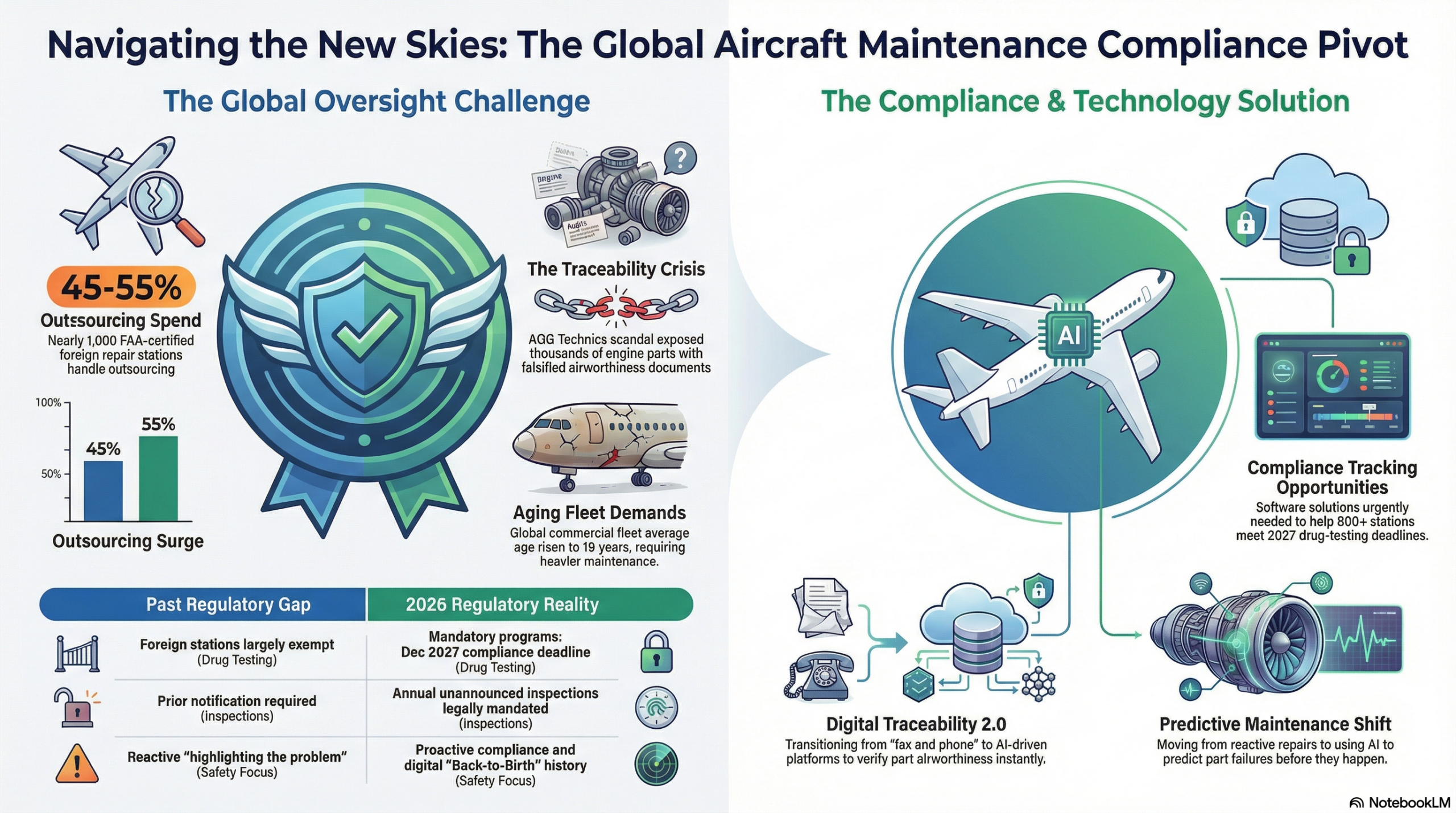
- Regulatory Tightening: The FAA Reauthorization Act of 2024 has closed significant historical gaps regarding foreign repair stations, mandating unannounced inspections and drug testing. This has shifted the market opportunity from identifying regulatory “loopholes” to providing compliance solutions for the nearly 1,000 FAA-certified foreign facilities.
- The Traceability Premium: Following the massive AOG Technics counterfeit parts scandal, “Back-to-Birth” traceability has become the industry’s new premium currency. Systems that can verify the authenticity of Used Serviceable Material (USM) and Parts Manufacturer Approval (PMA) components are essential for operational safety and regulatory adherence.
The Global Maintenance Landscape
The aviation industry has seen a decadelong shift of major maintenance work to foreign territories, including China, Singapore, El Salvador, and Mexico. While this transition initially targeted cost reduction, it created a “Global Industrial Maintenance Complex” that is increasingly difficult to oversee.
Outsourcing Trends and Infrastructure
- Scale of Outsourcing: Maintenance outsourcing rose from 20% in 1990 to approximately 47% in 2016, a trend that has stabilized with 45–55% of maintenance spend currently sent to external providers.
- Facility Growth: There are currently approximately 977 FAA-certified foreign repair stations worldwide, a significant increase from the 731 reported in previous decades.
- Geographical Distribution:
- China: 78 facilities
- Singapore: 54 facilities
- Brazil: 22 facilities
- Thailand: 6 facilities
- Costa Rica: 3 facilities
- El Salvador: 2 facilities
The Oversight Challenge
Historically, the “Inspection Challenge” involved oversight across vast distances—such as inspectors in Los Angeles managing facilities in Beijing (6,500 miles away). Prior to 2024, the “element of surprise” was often compromised by requirements for foreign government permission and visa notifications.
Regulatory Evolution: FAA Reauthorization Act of 2024
Recent legislative updates have fundamentally altered the legal reality for foreign repair stations. The focus for 2026 and beyond is assisting these stations in meeting new, stringent deadlines.
| Regulatory Area | Historical Status | Current Reality (Post-2024/2025) | Compliance Deadline |
| Drug & Alcohol Testing | Foreign stations were largely exempt. | Final Rule (Dec 2024) requires testing programs. | December 20, 2027 |
| Surprise Inspections | Logistically impossible; required notification. | Annual unannounced inspections are now mandated. | Ongoing (Active) |
| FAA Certification | Discrepancies in mechanic certification. | Stricter oversight and push for standardized qualifications. | Ongoing |
The 2026 Spare Parts Market
The aircraft spare parts market is experiencing unprecedented growth, with the total market (OEM + Aftermarket) estimated at 723.8 billion in 2025**, projected to reach **1.06 trillion by 2032 (CAGR ~5.6%).
Critical Market Dynamics
- The “Parts Drought”: Lead times for new OEM parts often exceed 12 months, leading to a shortage of “rotables” like landing gear and avionics.
- Used Serviceable Material (USM): Valued at $7.6 billion in 2025, USM is 30–40% cheaper than new parts and supports “Circular Economy” goals.
- Parts Manufacturer Approval (PMA): These third-party parts are gaining mainstream acceptance due to OEM shortages, with an expected annual growth rate of 7.8%.
- Supply Chain Inflation: Spare parts inflation (2.5–3.5%) is significantly outstripping the inflation rate for new aircraft (1.1%).
The AOG Technics Scandal
A major fraud scandal involving a UK-based broker, AOG Technics, exposed the industry’s vulnerability to counterfeit components. Thousands of engine parts for the CFM56 engine were sold with falsified airworthiness documents. This has led to:
- Global grounding and inspection mandates.
- Slower processing times for part certification.
- A “dirty fingerprint” trail requirement for all documentation.
Technological Solutions and Business Opportunities
The complexities of the “Global Industrial Maintenance Complex” provide significant opportunities for technological intervention, particularly in tracking and making sense of the supply chain.
Strategic Solution Areas
- Enhanced Traceability: Systems must verify FAA Form 8130-3 (Airworthiness Approval Tag) and maintain “Back-to-Birth” history to mitigate fraud.
- Compliance Tracking: Automating the transition for foreign stations to meet the 2027 drug and alcohol testing deadline.
- Remote Inspection Technologies: Utilizing IoT and Augmented Reality (AR) to facilitate virtual oversight where geographical barriers remain.
- Predictive Maintenance: Leveraging AI and data analytics to shift from reactive to predictive purchasing, reducing Aircraft on Ground (AOG) time.
- Digital Marketplaces: Transitioning from “fax and phone” trading to blockchain or AI-verified platforms for price transparency.
Emerging Sector Integration
New aviation technologies, such as the electric eVTOL aircraft developed by Beta Technologies, require specialized maintenance training and standardized mechanic certification. Additionally, automated logistics solutions, such as the “DeReticular” drone systems for part delivery, are becoming integral to the “Just-in-Case” inventory model.
Funding and Commercialization Strategy
Developing data tracking and maintenance solutions aligns with Small Business Innovation Research (SBIR) and Small Business Technology Transfer (STTR) programs.
Current SBIR/STTR Status (As of February 2026)
- Authorization Lapse: The SBIR/STTR program authorization lapsed on October 1, 2025.
- Impact: Standard solicitation cycles (e.g., DoD 26.1) are currently paused or delayed.
- Recommendation: Organizations must monitor the Defense SBIR/STTR Innovation Portal (DSIP) for interim schedules rather than relying on historical January/April/August cadences.
Key Partnership Opportunities
- Beta Technologies (Vermont): A prime candidate for maintenance training and certification standardization projects.
- Vermont Manufacturing Extension Center (VMEC): An essential partner for manufacturing and supply chain optimization.
- Department of Transportation (DOT): Potential funding source for innovations enhancing transportation safety and infrastructure tracking.