Infrastructure in a Suitcase A Simple Guide to the RIOS Pilot Expeditionary
Imagine a hurricane has just torn through a remote coastal town. The power grid is down, cell towers are destroyed, and roads are impassable. First responders arrive to a scene of chaos with no way to communicate, coordinate, or process information. What if, in this exact moment, they could open a few suitcases and, within 90 seconds, deploy a self-powered communications hub, an intelligent data analysis center, and a secure local network?
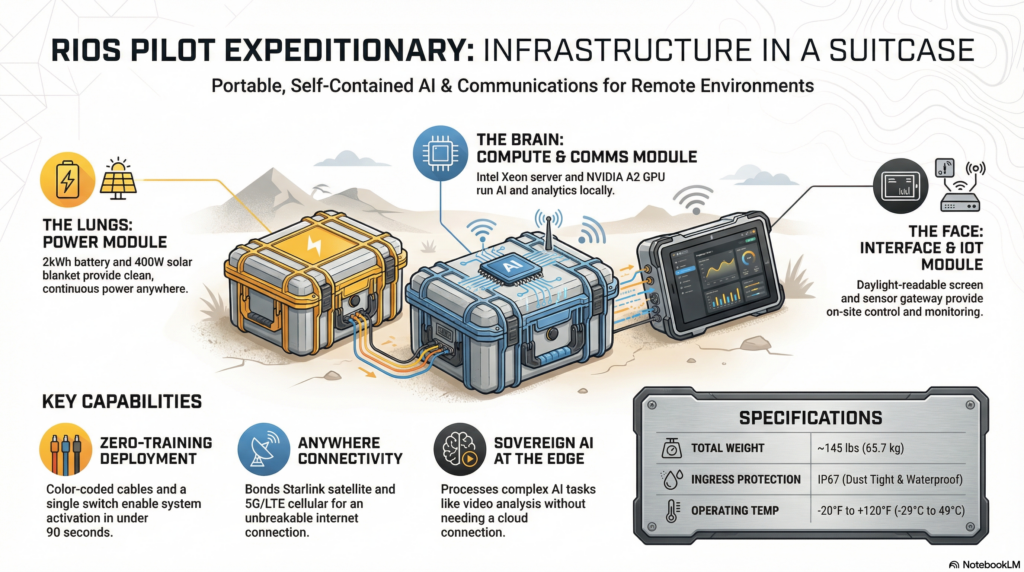
This is the problem the RIOS Pilot Expeditionary is built to solve. It is a complete, high-tech infrastructure system designed to be carried by hand and deployed anywhere on Earth, independent of any existing support.
“Infrastructure in a Suitcase. The First-In Solution.”
This document will break down the core concepts behind this technology, exploring how it packs the power of a data center into a portable, three-case system.
——————————————————————————–
1. The Big Idea: Your Own Private Cloud, Anywhere
To understand the RIOS system, you first need to grasp two powerful ideas that make it unique: the “sovereign cloud” and “edge AI.”
What is a “Sovereign Cloud”?
Think of the public cloud (like Amazon Web Services or Google Cloud) as renting an apartment in a massive, city-sized building. It’s convenient and powerful, but you don’t own the building, and your data lives on someone else’s property.
The RIOS system is the opposite. It’s like owning a high-tech, self-sufficient RV. It is a sovereign cloud, which means the physical computers that store and process your information are right there with you, running the RIOS Sovereign OS. Your data stays with you, completely secure and under your control, even if you are totally disconnected from the global internet.
What is “Edge AI”?
Artificial Intelligence often relies on sending data to massive, distant data centers for analysis. Edge AI flips that model.
Imagine you have a highly trained expert—like a doctor or a language translator—standing right next to you in the field. They can give you an immediate diagnosis or translation without needing to call back to the main office for help. This is AI Inference at the edge. The RIOS system’s powerful NVIDIA A2 AI chip acts as that on-site expert, allowing you to run “Sovereign AI“—performing complex tasks instantly, such as:
- Identifying specific objects in live video feeds.
- Analyzing drone maps to assess crop health.
- Recognizing license plates on a remote road.
These two concepts—total data ownership and on-site intelligence—are the foundation of the system. Now, let’s look at the hardware that makes it possible.
——————————————————————————–
2. Meet the “Mission Stack”: The Three-Case System
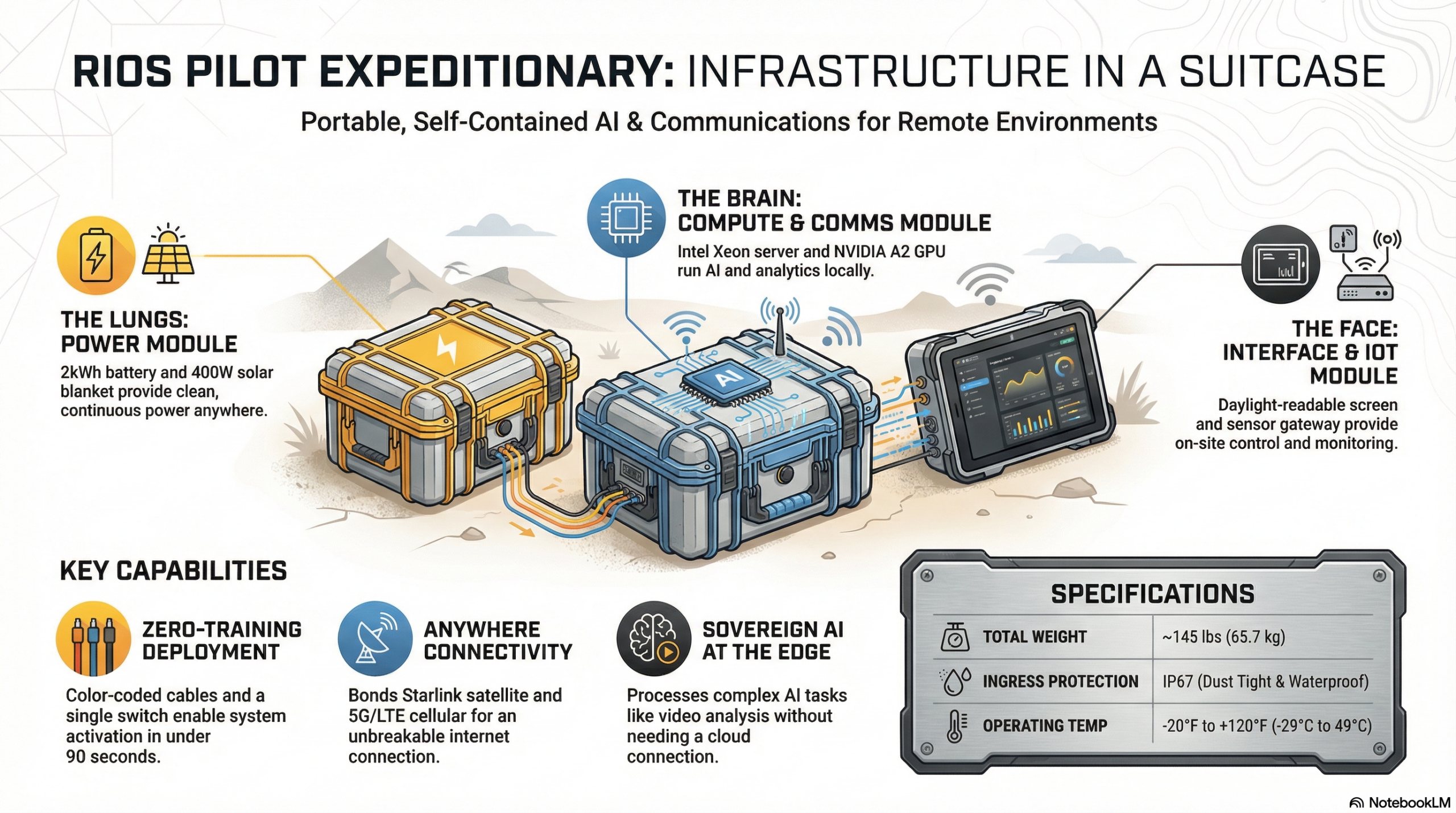
The RIOS Pilot Expeditionary is a modular system composed of three rugged, IP67-rated (dust-tight and waterproof), color-coded, and interlocking B&W Type 61 cases. Each case weighs approximately 48 lbs (21.7 kg), making the entire system man-portable. While each case has a specific job, they are designed with tool-less connectors to work together as a single, cohesive organism.
| Case (Color & Analogy) | Core Purpose | Key Components (Simplified) |
| 🟡 The Lungs (Power Module) | To generate and store clean, reliable electricity, independent of any grid. | 400W Foldable Solar Blanket, 2kWh Internal Battery |
| 🔵 The Brain (Compute & Comms) | To think, process data, run AI tasks, and communicate with the outside world. | Intel Xeon Server, NVIDIA A2 AI Chip, Starlink & 5G/LTE Modems |
| ⚫ The Face (Interface & IoT) | To allow a human to interact with the system and for the system to sense its local environment. | Daylight-Readable Screen, Weatherproof Keyboard, Long-Range Sensor Gateway |
🟡 The Lungs (Power)
As the Lungs, the yellow case is the system’s independent power plant. Its primary job is to guarantee a continuous stream of clean electricity, decoupling the sensitive electronics from unreliable sources like a sputtering field generator. It uses a 400W Mil-Spec Canvas foldable solar blanket to generate power and stores it in a large 2kWh internal LiFePO4 battery—a chemistry chosen for its superior thermal stability and long cycle life. Industrial-grade Victron components manage the power flow, ensuring maximum efficiency.
🔵 The Brain (Compute)
The blue case is the operational heart of the system—its Brain. It houses a server-grade Intel Xeon D-2146NT processor and the NVIDIA A2 AI chip in a sealed, fanless chassis. This is where all the thinking happens. The Xeon D-Series was specifically chosen for its balance of high core count and low thermal design power (TDP), delivering workstation-class performance with battery efficiency. To communicate with the rest of the world, it contains an integrated router that can bond signals from a Starlink satellite dish and a 5G/LTE cellular modem, ensuring the most reliable connection possible.
⚫ The Face (Interface)
The black case is the human interaction point, or the Face of the system. Its lid contains a large, 22-inch High-Nit (Daylight Readable) screen and a weatherproof keyboard and trackball. This is how an operator in the field controls the system. It also houses a RIOS NeoMesh Gateway, a special radio that allows the system to communicate with small, low-power sensors (like soil monitors or perimeter tripwires) up to 5 miles away.
With a clear picture of what the system is, we can now explore what it does.
——————————————————————————–
3. From Cases to Capabilities: How It Works in the Real World
The system is designed for rapid, “zero-training” deployment by non-technical users.
Deployment in Under 90 Seconds
The operational workflow turns a complex set of technology into a simple appliance.
- Land: Place the three cases at the operational site.
- Connect: Plug the color-coded cables into their matching ports: the yellow power cable connects the Lungs to the Brain, and the blue data cable connects the Brain to the Face.
- Deploy: Unfold the solar blanket and set up the Starlink dish.
- Activate: Flip the single master switch on the yellow Power Module.
Within 90 seconds, the system boots up, connects to the internet via satellite, and creates a secure, local Wi-Fi bubble for users and connected devices.
Example Missions
The combination of mobility, power independence, and on-site intelligence unlocks a range of capabilities.
- Disaster Response: After a hurricane, the system can be deployed on high ground to instantly establish a digital command post. It provides communications for rescue teams and a hub for registering victims where all other infrastructure has failed.
- Agricultural Scouting: An agricultural team can land at a potential farm site in a remote area. Using the RIOS system, they can immediately analyze drone maps and soil samples with the onboard AI to determine the viability of the land before committing heavy machinery and resources.
- Remote Security: The system can monitor a construction site or mine perimeter in the middle of nowhere. Using its AI, it can intelligently analyze camera feeds to detect and alert for intruders without needing a generator, a guard shack, or a constant internet connection.
These real-world applications highlight the core advantages the system provides.
——————————————————————————–
4. Key Takeaways: The RIOS Advantage
For a new user, the benefits of the RIOS Pilot Expeditionary can be distilled into five key advantages.
- True Mobility The entire system is man-portable, with each of the three cases weighing around 48 lbs. It fits in a standard SUV or helicopter and requires no special equipment like cranes or flatbed trucks for deployment.
- Energy Independence By running primarily on a 400W solar blanket and storing power in a 2kWh battery, the system eliminates the need for fuel, noisy generators, or a connection to a power grid. It can operate indefinitely with sufficient sunlight.
- On-Site Intelligence Powerful AI processing happens locally on the NVIDIA A2 chip. This means insights are generated instantly, without the delay or security risk of sending sensitive data to a distant cloud server.
- “Zero-Training” Simplicity The color-coded, plug-and-play design and single-switch activation allow users with no technical background to deploy it successfully. This dramatically reduces the risk of human error in high-stress situations.
- All-in-One Solution The RIOS system replaces an entire stack of separate, complex gear—diesel generators, server racks, satellite modems, cellular routers, enterprise-grade batteries, inverters, and monitors—with a single, fully integrated, and pre-configured solution, eliminating deployment risks and saving tens of thousands in equipment and specialized labor costs.
Ultimately, the RIOS Pilot Expeditionary is more than just hardware; it is a “Civilization Seed.” It’s the tool that allows pioneers, responders, and innovators to establish a digital baseline anywhere on the planet, turning disconnected chaos into a hub of power, connectivity, and intelligence.