The Unbreakable Node: Why We Built the RIOS Far X
By Michael Noel, Founder of DeReticular[1][2]
In the lexicon of modern infrastructure, there is a word that has been quietly weaponized against rural communities: “Coverage.”
Telecomm giants sell you “coverage.” They show you a map, painted in reassuring shades of magenta or blue, claiming your farm, your town, or your job site is connected. But anyone who actually lives at the edge knows the truth. “Coverage” is a lie. Coverage is a signal bar that appears when you stand on the roof but vanishes when you walk into the barn. Coverage is a connection that works on Tuesday but fails during the Wednesday storm.
At DeReticular, we don’t care about “coverage.” We care about Dominance.
If you are building a sovereign economy—if you are running autonomous tractors, syncing distributed ledgers, or training AI models in the field—you cannot rely on a signal that is merely “present.”[3] You need a signal that is inevitable.
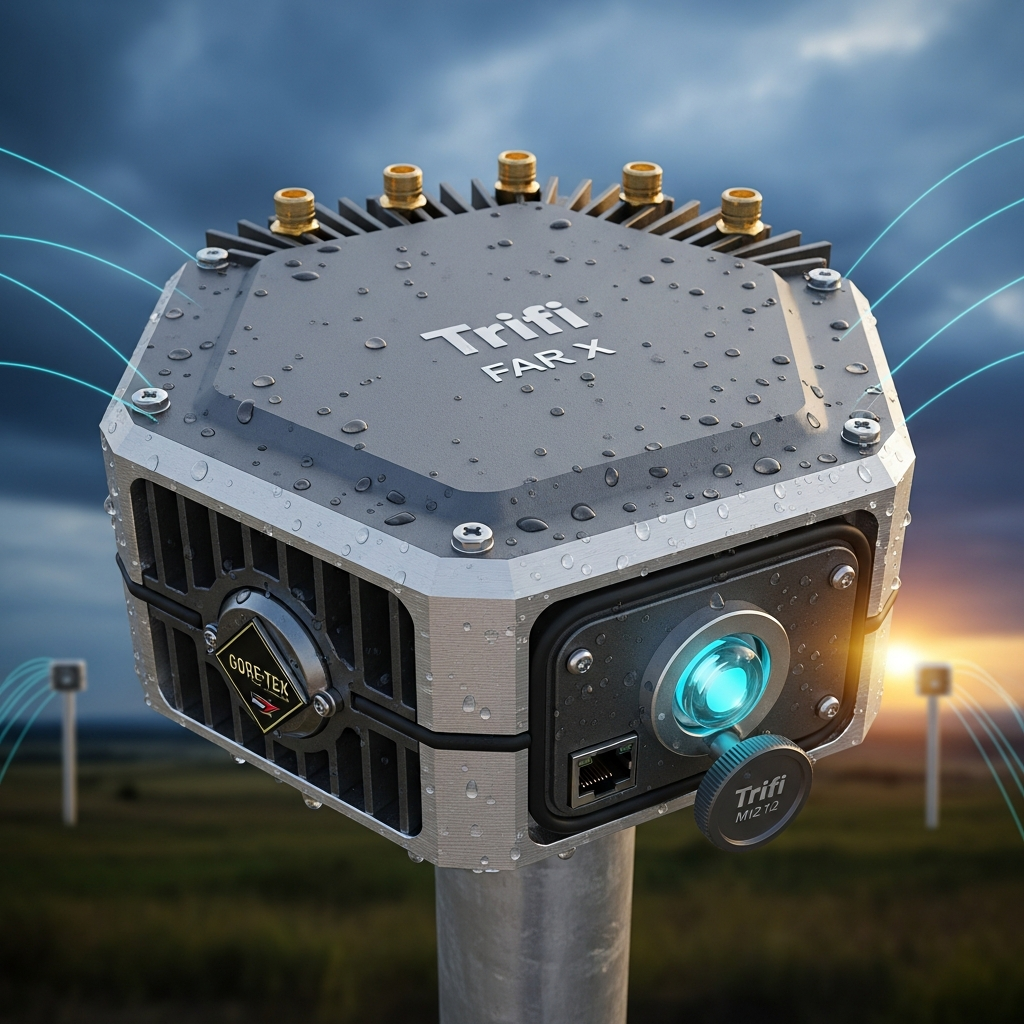
That is why we built the RIOS Far X – Industrial Wi-Fi 6 Mesh Router.
The Problem with “Consumer” Gear
When we started deploying the RIOS-CC-1000 Compute Clusters, we hit a physical wall. We had these massive engines of economic power—supercomputers sitting in shipping containers—but the “last mile” to connect them to the actual work (the sensors, the drones, the people) was being bridged by plastic routers designed for suburban living rooms.
We tried everything. We bought the “Pro” gear. We bought the “Mesh” systems. They all failed. They melted in the Arizona sun. They choked on the dust of the Great Plains. They required cloud subscriptions to “unlock” features we already paid for. And worst of all, when the internet went down, they became expensive paperweights.
We realized that if we wanted a network that could survive the reality of the Rural Infrastructure Operating System (RIOS), we had to build it ourselves.
Enter the Far X: The Cognitive Mesh
The RIOS Far X is not an access point. It is a territorial claim.
We engineered it with three non-negotiable mandates: Ruggedization, Autonomy, and Intelligence.
1. Built Like a Tank (Literally)
Go ahead, mount it on the silo. The Far X is housed in a die-cast, IP67-rated aluminum chassis. It laughs at rain, sleet, and the kind of dust that kills lesser electronics in a week. With an operating range of -40°C to +75°C, it is designed to survive environments that would void the warranty of any other device you own.
2. The Death of the “Dead Zone”
The Far X doesn’t just broadcast Wi-Fi; it creates a RIOS Cognitive Mesh.
In a traditional network, if the main router dies, everyone goes offline. The Far X is different. It is self-healing.[4] If a tractor cuts a fiber line or a storm takes out a node, the other Far X units in the array instantly re-calculate the topology, re-routing traffic in milliseconds. Your autonomous harvester doesn’t stop. Your data stream doesn’t stutter. The network survives because it thinks.
3. Sovereign Connectivity (vSIM Technology)
This is the game-changer. Every Far X unit comes embedded with Trifi Wireless vSIM technology.
Imagine your fiber line gets cut. In a normal setup, you are dark. But the Far X is watching. The moment it detects a drop in backhaul integrity, it activates its internal cellular modems, negotiating with every available carrier (LTE, 5G, it doesn’t care) to keep your data flowing. It bonds these connections together, creating an unshakeable lifeline to the internet that no single ISP failure can sever.
The Nervous System of the AI Economy
Why does this matter? Because in the RIOS ecosystem, data is money.
When your RIOS-CC-1000 is crunching numbers for a global client, it needs a constant stream of local data—weather patterns, soil telemetry, logistics tracking. The Far X is the nerve ending that gathers this data.
It runs the RIOS Network Kernel, meaning it natively understands the difference between a Netflix stream and a mission-critical inference packet. It prioritizes the work that pays you.[5] It ensures that your “Data Flywheel” never stops spinning, regardless of what is happening on the rest of the network.
Take Back Your Territory
For too long, rural infrastructure has been defined by what we lack. Lack of options, lack of speed, lack of reliability. The RIOS Far X is our answer to that deficit.
It is a declaration that the edge is no longer a passive consumer of connectivity. We are producers. We are owners. And we are finished with “coverage.”
It is time to build a network that works as hard as you do.
The RIOS Far X is available for immediate deployment. Secure your perimeter today at the DeReticular Shop.
[View Technical Specifications & Pricing]
Sourceshelp
The Unbreakable Node: Why We Built the RIOS Far X
By Michael Noel, Founder of DeReticular[1][2]
In the lexicon of modern infrastructure, there is a word that has been quietly weaponized against rural communities: “Coverage.”
Telecomm giants sell you “coverage.” They show you a map, painted in reassuring shades of magenta or blue, claiming your farm, your town, or your job site is connected. But anyone who actually lives at the edge knows the truth. “Coverage” is a lie. Coverage is a signal bar that appears when you stand on the roof but vanishes when you walk into the barn. Coverage is a connection that works on Tuesday but fails during the Wednesday storm.
At DeReticular, we don’t care about “coverage.” We care about Dominance.
If you are building a sovereign economy—if you are running autonomous tractors, syncing distributed ledgers, or training AI models in the field—you cannot rely on a signal that is merely “present.”[3] You need a signal that is inevitable.
That is why we built the RIOS Far X – Industrial Wi-Fi 6 Mesh Router.
The Problem with “Consumer” Gear
When we started deploying the RIOS-CC-1000 Compute Clusters, we hit a physical wall. We had these massive engines of economic power—supercomputers sitting in shipping containers—but the “last mile” to connect them to the actual work (the sensors, the drones, the people) was being bridged by plastic routers designed for suburban living rooms.
We tried everything. We bought the “Pro” gear. We bought the “Mesh” systems. They all failed. They melted in the Arizona sun. They choked on the dust of the Great Plains. They required cloud subscriptions to “unlock” features we already paid for. And worst of all, when the internet went down, they became expensive paperweights.
We realized that if we wanted a network that could survive the reality of the Rural Infrastructure Operating System (RIOS), we had to build it ourselves.
Enter the Far X: The Cognitive Mesh
The RIOS Far X is not an access point. It is a territorial claim.
We engineered it with three non-negotiable mandates: Ruggedization, Autonomy, and Intelligence.
1. Built Like a Tank (Literally)
Go ahead, mount it on the silo. The Far X is housed in a die-cast, IP67-rated aluminum chassis. It laughs at rain, sleet, and the kind of dust that kills lesser electronics in a week. With an operating range of -40°C to +75°C, it is designed to survive environments that would void the warranty of any other device you own.
2. The Death of the “Dead Zone”
The Far X doesn’t just broadcast Wi-Fi; it creates a RIOS Cognitive Mesh.
In a traditional network, if the main router dies, everyone goes offline. The Far X is different. It is self-healing.[4] If a tractor cuts a fiber line or a storm takes out a node, the other Far X units in the array instantly re-calculate the topology, re-routing traffic in milliseconds. Your autonomous harvester doesn’t stop. Your data stream doesn’t stutter. The network survives because it thinks.
3. Sovereign Connectivity (vSIM Technology)
This is the game-changer. Every Far X unit comes embedded with Trifi Wireless vSIM technology.
Imagine your fiber line gets cut. In a normal setup, you are dark. But the Far X is watching. The moment it detects a drop in backhaul integrity, it activates its internal cellular modems, negotiating with every available carrier (LTE, 5G, it doesn’t care) to keep your data flowing. It bonds these connections together, creating an unshakeable lifeline to the internet that no single ISP failure can sever.
The Nervous System of the AI Economy
Why does this matter? Because in the RIOS ecosystem, data is money.
When your RIOS-CC-1000 is crunching numbers for a global client, it needs a constant stream of local data—weather patterns, soil telemetry, logistics tracking. The Far X is the nerve ending that gathers this data.
It runs the RIOS Network Kernel, meaning it natively understands the difference between a Netflix stream and a mission-critical inference packet. It prioritizes the work that pays you.[5] It ensures that your “Data Flywheel” never stops spinning, regardless of what is happening on the rest of the network.
Take Back Your Territory
For too long, rural infrastructure has been defined by what we lack. Lack of options, lack of speed, lack of reliability. The RIOS Far X is our answer to that deficit.
It is a declaration that the edge is no longer a passive consumer of connectivity. We are producers. We are owners. And we are finished with “coverage.”
It is time to build a network that works as hard as you do.
The RIOS Far X is available for immediate deployment. Secure your perimeter today at the DeReticular Shop.
[View Technical Specifications & Pricing]
Sourceshelp